Cisco ASR 9000 Series Ethernet Line Cards
Available Languages
Product Overview
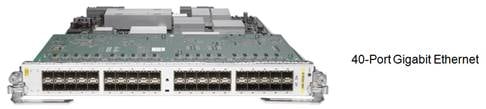
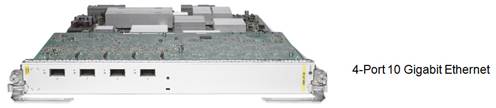
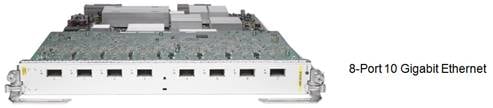
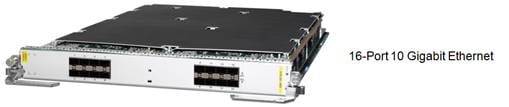
The Cisco® ASR 9000 Series Ethernet Line Cards are the latest generation of service-provider-focused Carrier Ethernet line cards from Cisco. These line cards deliver economical, scalable, highly available, line-rate Ethernet and IP/Multiprotocol Label Switching (IP/MPLS) edge services. The Cisco ASR 9000 Series Line Cards and other Cisco ASR 9000 Series platform components are designed to provide the fundamental infrastructure for scalable Carrier Ethernet and IP/MPLS networks, supporting profitable business, residential, and mobile services (Figure 1).
Features and Benefits
Each Cisco ASR 9000 Series Ethernet Line Card provides hierarchical quality of service (HQoS) and simultaneous support for both Layer 2 and Layer 3 services and features, allowing operators to qualify and stock a single line card that can be deployed in any combination of Layer 2 and Layer 3 applications. This capability helps to reduce capital expenditures (CapEx) and operating expenses (OpEx), as well as reduce the time required to develop and deploy new services. With support for up to 512,000 queues, 32,000 interfaces, 1.3 million routes, 1 million MAC addresses, and 36,000 VPNs, the Cisco ASR 9000 Series Ethernet Line Cards set a new standard for service density, allowing operators to offer predictable, managed transport services while optimizing the use of network assets.
With their synchronization circuitry and dedicated backplane timing traces for accessing the route switch processor’s (RSP’s) Stratum-3 subsystem, the Cisco ASR 9000 Series Ethernet Line Cards provide standards-based line-interface functions for delivering and deriving transport-class network timing, enabling support of network-synchronized services and applications such as mobile backhaul and time-division multiplexing (TDM) migration. Recognizing that real-time media dominate next-generation services, Cisco has integrated media-monitoring technology into the Cisco ASR 9000 Series Ethernet Line Cards. This multimedia technology supports real-time, standards-based monitoring and statistics collection of real-time video and voice flows, delivering proactive maintenance and management of today’s media-rich services.
Addressing the advantages of consolidating IP and dense wavelength division multiplexing (DWDM) networking, G.709 with Advanced Forward Error Correction (FEC) is provided. G.709 provides visibility into the DWDM transmission system to provide rapid detection and recovery from transmission-layer and DWDM impairments. Before traffic is lost and a link outage occurs, G.709 can also be configured for proactive protection if signal degradation is detected. The Advanced FEC extends transmission-layer performance, delivering extended performance over an amplified system without the cost of regeneration or transponders.
Table 1 lists the features and benefits of the Cisco ASR 9000 Series Line Cards. Scale support is software and hardware dependent.
Table 1. Features and Benefits of Cisco ASR 9000 Series Line Cards
| Feature |
Benefit |
| Portfolio |
|
| 40-port Gigabit Ethernet |
40-port 10/100/1000 Mbps, Small Form-Factor Pluggable (SFP)-based line card |
| 4-port 10 Gigabit Ethernet |
4-port 10 Gbps, 10-Gigabit Small Form-Factor Pluggable (XFP)-based line card |
| 8-port 10 Gigabit Ethernet |
8-port 10 Gbps, oversubscribed XFP-based line card |
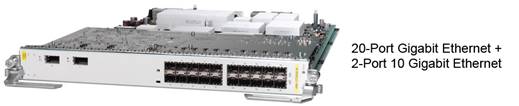
| 2-port 10 Gigabit Ethernet + 20-port Gigabit Ethernet |
2-port 10 Gbps, XFP-based and 20-port 100/1000 Mbps, SFP-based line card |
| 8-port 10 Gigabit Ethernet |
8-port 10 Gbps, XFP-based line card |
| 16-port 10 Gigabit Ethernet |
16-port 10 Gbps, oversubscribed SFP+-based line card |
| Interface Support |
|
| Mixed fiber and electrical |
Short reach (SR), intermediate reach (IR), long reach (LR), coarse wavelength-division multiplexing (CWDM), dense wavelength-division multiplexing (DWDM), and 10/100/1000BASE-T |
| G.709 and Advanced FEC (available on Cisco 9000 Series 2T 20 GE-B/E 10 GE line card ports, and 8-port 10 Gigabit Ethernet line card ports) |
Standard G.709 providing transmission-layer operations, administration, and maintenance, (OA&M) G.709 Standard FEC and Advanced FEC enhanced transmission system performance |
| SFP, XFP, and SFP+ interfaces |
SFP, XFP, and SFP+ interfaces provide mixing and matching of interface types (of the same kind) across a single line card, including copper 10/100/1000; optical SX, LX, ZX, and GE SFP interfaces; 100-Mbps FX SFP interfaces; and DWDM and CWDM GE SFP interfaces, as well as support for LR, ER, ZR, and ITU-T DWDM XFP interfaces. For a complete list of supported interfaces, please see the Cisco ASR 9000 Transceiver Modules data sheet. |
| Scalable and Integrated Multiservice Support |
|
| Layer 2 and Layer 3 services |
Combined IP, MPLS, Ethernet, Layer 2 VPN (L2VPN), and Layer 3 VPN (L3VPN) services |
| Service density |
Up to 32,000 Layer 2 and Layer 3 services interfaces and 512,000 queues |
| Routes and MACs |
1.3 million IPv4 routes and up to 1 million IEEE MAC addresses |
| VPNs |
Up to 32,000 L2VPNs and 4000 L3VPNs |
| (R)Evolutionary Monitoring |
|
| Carrier-class OA&M and reliability |
NetFlow, 802.1ag, 802.3ah, Y.1731 Fault Management and Performance Monitoring, IP service-level agreement (IP SLA), E-LMI, Bidirectional Forwarding Detection (BFD), BGP Prefix Independent Convergence (PIC) Core and Edge, virtual circuit connectivity verification (VCCV), ping, and traceroute |
| Video Monitoring |
Video Monitoring (VidMon) provides real-time monitoring of video flows, including the issuance of alarm upon degradation. |
| Carrier-Grade OS |
|
| Cisco IOS® XR Software |
Modular, patchable, restartable, scalable, highly available, carrier-core and edge-proven operating system |
| T-Class Synchronization |
|
| Synchronization |
Derive and provide synchronization from and to Ethernet interfaces, Cisco ASR 9000 RSP, and network synchronization interfaces |
Line Card Types
The Cisco ASR 9000 Series Line Cards are available in three scale types: Low Queue, Medium Queue, and High Queue. Each line card type provides the same features and performance. Line card types may be mixed within the same system. Table 2 lists the main differences between the line card types. Specific scale support is hardware and software dependent.
Table 2. Line Card Types
| Feature |
Low Queue |
Medium Queue |
High Queue |
| Total queues |
8 per port |
96,000 – 192,000 |
376,000 - 512,000 |
| Policers |
8000 |
64,000 – 128,000 |
256,000 – 512,000 |
| Ethernet flow points (EFPs) |
4000 |
16,000 |
32,000 |
Line Card Feature Licenses
Optional feature licenses can be used with the line cards. These include licenses for enabling Layer 3 VPNs, G.709 and FEC, Lawful Intercept, and Video Monitoring. The L3VPN Line Card Licenses provide access to system VPN Routing and Forwarding (VRF) instances on a line card basis. Table 3 shows the VRF scale and line card compatibility of the three Layer 3 VPN licenses.
Table 3. L3VPN Feature Licenses
| L3VPN License Part Number |
Feature |
Low Queue Line Card |
Medium Queue Line Card |
High Queue Line Card |
| A9K-IVRF-LIC |
Up to 8 VRF instances |
X |
X |
X |
| A9K-AIP-LIC-B |
Full-scale VRF instances |
X |
X |
Not applicable |
| A9K-AIP-LIC-E |
Full-scale VRF instances |
Not applicable |
Not applicable |
X |
The Advanced Optical Line Card (A9K-ADV-OPTIC-LIC) License enables G.709 and FEC on a per-line-card basis. This license may be used on line cards with part numbers A9K-2T20GE-L, A9K-2T20GE-B, A9K-2T20GE-E, A9K-8T-L, A9K-8T-B, A9K-8T-E and A9K-16T/8-B.
The Lawful Intercept License allows traffic traversing the Cisco ASR 9000 to be tapped by law enforcement agencies. This license may be used on any line card and is purchased on a per-line-card basis.
The Video Monitoring (A9K-ADV-VIDEO-LIC) License is a system license. This license allows inline video-flow monitoring on all of the Ethernet line cards within the system.
Product Specifications
Table 4 provides product specifications. Scale support is software and hardware dependent.
Table 4. Product Specifications
| Description |
Specification |
|
| Cisco IOS XR Software support |
●
Modular software design: Cisco IOS XR Software demonstrates Cisco networking leadership in helping customers realize the power of their networks and the Internet. The software provides exceptional routing-system scalability, high availability, service isolation, and manageability to meet the mission-critical requirements of next-generation networks.
●
Operating system infrastructure protection: Cisco IOS XR Software provides a microkernel architecture that forces all but the most critical functions, such as memory management and thread distribution, outside of the kernel. This setup prevents failures in applications, file systems, and even device drivers from causing widespread service disruption.
●
Process and thread protection: Each process – even individual process threads – occurs in its own protected memory space, and communications between processes are accomplished through well-defined, secure, and version-controlled application programming interfaces (APIs). This setup significantly minimizes the effect that any process failure can have on other processes.
●
Process restart: The line cards offer the ability to restart critical control-plane processes both manually and automatically in response to a process failure, rather than restarting the entire OS. This feature helps to support the Cisco IOS XR Software goal of continuous system availability and allows for quick recovery from process or protocol failures with minimal disruption to customers or traffic.
●
State checkpointing: The line cards offer the capability to maintain a memory and critical operating state across process restarts so that routing adjacencies and signaling state can be maintained during an RSP switchover.
|
|
| Flexible Ethernet services |
●
Ethernet virtual connections (EVCs): Ethernet services are supported using individual EVCs to carry traffic belonging to a specific service type or end user through the network. EVC-based services can be used in conjunction with MPLS-based L2VPNs and native Ethernet switching deployments.
●
Flexible VLAN classification: VLAN classification into EFPs includes single-tagged VLANs, double-tagged VLANs (QinQ and 802.1ad), contiguous VLAN ranges, and noncontiguous VLAN lists.
●
IEEE bridging: The line cards support native bridging based on IEEE 802.1Q, IEEE 802.1ad, 802.1ah, and QinQ VLAN encapsulation mechanisms.
●
IEEE 802.1s Multiple Spanning Tree (MST): MST extends the 802.1w Rapid Spanning Tree Protocol (RSTP) to multiple spanning trees, providing rapid convergence and load balancing.
●
MST Access Gateway: The MST Access Gateway provides a resilient, fast-convergence mechanism for aggregating and connecting to Ethernet-based access rings.
|
|
| L2VPN services |
●
Virtual Private LAN Services (VPLS): These services are included in a class of VPN that supports the connection of multiple sites in a single bridged domain over a managed IP/MPLS network. VPLS presents an Ethernet interface to customers, simplifying the LAN and WAN boundary for service providers and customers, and supporting rapid and flexible service provisioning, because the service bandwidth is not tied to the physical interface. All services in a VPLS appear to be on the same LAN, regardless of location.
●
Hierarchical VPLS (HVPLS): HVPLS provides a level of hierarchy at the edge of the VPLS network for increased scale. Two options of HVPLS are supported: QinQ access and Ethernet over MPLS (pseudowire) access.
●
Virtual Private Wire Service (VPWS) with Ethernet over MPLS (EoMPLS): EoMPLS transports Ethernet frames across an MPLS core using pseudowires. Individual EFPs or traffic from an entire port can be transported over the MPLS backbone using pseudowires to an egress interface or subinterface.
●
Pseudowire redundancy: Pseudowire redundancy supports the definition of a backup pseudowire to protect a primary pseudowire that fails.
●
G.8032: G.8032 is a feature that provides the sub-50-ms protection for Ethernet traffic in a ring topology. The implementation on the Cisco ASR 9000 Series is compliant with version 2 of the ITU-T standard.
●
Multisegment pseudowire stitching: Multisegment pseudowire stitching is a method for interworking two pseudowires together to form a cross-connect relationship.
|
|
| Multicast |
●
IPv4 Multicast: The line cards support Internet Group Management Protocol Versions 2 and 3 (IGMPv2 and v3), Protocol Independent Multicast-Source Specific Multicast (PIM-SSM), PIM sparse mode (PIM-SM), PIM SSM Mapping, Multicast Source Discovery Protocol (MSDP), Multicast VPN, and Anycast rendezvous point (RP).
●
IGMP v2 and v3 snooping: This Layer 2 mechanism efficiently tracks multicast membership on an L2VPN network. Individual IGMP joins are snooped at the VLAN level or pseudowire level and then results are summarized into a single upstream join message. In residential broadband deployments, this scenario allows the network to send only channels that are being watched to the downstream users.
|
|
| OA&M |
●
Ethernet OA&M (EOAM) (IEEE 802.3ah): Ethernet link layer OA&M is a vital component of EOAM that provides physical-link OA&M to monitor link health and assist in fault isolation. Along with 802.1ag, Ethernet link layer OA&M can be used to assist in rapid link-failure detection and signaling to remote end nodes of a local failure.
●
EOAM (IEEE 802.1ag): Ethernet Connectivity Fault Management (E-CFM) is a subset of EOAM that provides numerous protocols and procedures that allow discovery and verification of the path through 802.1 bridges and LANs.
●
EOAM (ITU Y.1731): Y.1731 provides two separate feature sets: Fault Management (FM) and Performance Monitoring (PM). Fault Management builds on 802.1ag message types to allow verification of the Ethernet network and provide a toolset for troubleshooting any found faults. Performance Monitoring allows service providers to provide SLAs to their end customers by measuring the delay, latency, and loss across an Ethernet network.
●
Ethernet LMI (E-LMI): Ethernet Local Management Interface (E-LMI) is a protocol between the customer-edge (CE) device and the provider-edge (PE) device. It runs only on the PE-to-CE User Network Interface (UNI) link and notifies the CE device of connectivity status and configuration parameters of Ethernet services available on the CE port.
●
MPLS OA&M: The line cards support label switched path (LSP) ping, LSP traceroute, and VCCV.
|
|
| Layer 3 routing |
●
IPv4 routing: Cisco IOS XR Software supports a wide range of IPv4 services and routing protocols, including Border Gateway Protocol (BGP), Intermediate System-to-Intermediate System (IS-IS), Open Shortest Path First (OSPF), Routing Information Protocol (RIP), static, IPv4 Multicast, Routing Policy Language (RPL), and Hot Standby Router Protocol (HSRP) and Virtual Router Redundancy Protocol (VRRP) features.
●
IPv6 routing: Cisco IOS XR Software supports IPv6 services, including OSPFv3, IS-IS, Virtual Router Redundancy Protocol (VRRPv6), DHCPv6 relay, and static routing.
●
BGP Prefix Independent Convergence (PIC): BGP PIC provides the ability to converge BGP routes using the fast-convergence innovation that is distinctive to Cisco IOS XR Software.
|
|
| MPLS L3VPN |
●
MPLS L3VPN: The IP VPN feature for MPLS allows a Cisco IOS Software or Cisco IOS XR Software network to deploy scalable IPv4 Layer 3 VPN backbone services. An IP VPN is the foundation that companies use for deploying or administering value-added services, including applications and data-hosting network commerce, and telephony services to business customers.
●
Carrier supporting carrier (CSC): CSC allows an MPLS VPN service provider to connect geographically isolated sites using another backbone service provider and still maintain a private address space for its customer VPNs. CSC is implemented as defined by IETF RFC 4364.
●
Selective VRF Download: This feature provides the ability to selectively download VRF forwarding information base (FIB) entries to line cards that have VRF membership for each VRF. This provides larger FIB scale at a chassis level without burdening line cards with unnecessary FIB entries.
●
6PE and 6VPE: 6PE and 6VPE allow for introduction of IPv6 from the edge, in a scalable way, without any IPv6 addressing restrictions and without putting a well-controlled IPv4 backbone in jeopardy. This provides a solution that has minimal risk and operational cost with no effect on either the existing IPv4/MPLS backbone or edge and customer IPv6 networks.
|
|
| MPLS Traffic Engineering (TE) |
●
MPLS Traffic Engineering: Cisco IOS XR Software supports MPLS protocols, such as Traffic Engineering-Fast Reroute (TE-FRR), Resource Reservation Protocol (RSVP), Label Distribution Protocol (LDP), and Targeted Label Distribution Protocol (T-LDP).
●
MPLS Traffic Engineering Preferred Path: Preferred tunnel path functions let you map pseudowires to specific traffic engineering tunnels. Attachment circuits are cross-connected to specific MPLS TE tunnel interfaces instead of remote provider-edge router IP addresses (reachable using Interior Gateway Protocol [IGP] or LDP).
●
MPLS Traffic Engineering Auto-Bandwidth: MPLS TE automatic bandwidth adjustment provides the means to automatically adjust the bandwidth allocation for traffic engineering tunnels based on their measured traffic load.
●
Point to Multipoint (P2MP) Traffic Engineering:
The MPLS P2MP TE feature allows you to forward MPLS traffic from one source to multiple destinations. P2MP TE provides a single point of traffic control and the ability to configure explicit paths to optimize traffic distribution
, while benefitting from extending FRR protection to P2MP TE sub-LSPs.
|
|
| High availability |
●
MPLS TE-FRR: MPLS Traffic Engineering-FRR delivers Layer 3 protection switching for networks currently configured with MPLS LSP. MPLS TE-FRR provides temporary rerouting around a failed link, node, or path.
●
Bidirectional Forwarding Detection (BFD): BFD is a detection protocol that is designed to provide fast-forwarding path-failure detection times for all media types, encapsulations, topologies, and routing protocols.
●
802.3ad Link Aggregation Bundles: The line cards support a bundle of multiple links to provide added resiliency and the ability to load-balance traffic over multiple member links.
●
Multichassis Link Aggregation Group (MC-LAG): MC-LAG provides a standards-based 802.3ad bundle for a connecting device to reach a pair of Cisco ASR 9000 Series Aggregation Services Routers that appear as a single router to the connecting device. Rapid restoration times are possible even if there is a link or node failure, which improves the operational environment for the connecting device. MC-LAG can work with a long list of solutions on the Cisco ASR 9000 Series routers, such as business L2VPN and L3VPN, residential service backhaul, mobile aggregation, and service provider edge.
|
|
| Manageability |
Cisco IOS XR Software manageability: This feature provides industry-standard management interfaces, including modular command-line interface (CLI), Simple Network Management Protocol (SNMP), Cisco Discovery Protocol (CDP), Link Layer Discovery Protocol (LLDP) and native XML interfaces. Smart Call Home (SCH): This proactive support capability identifies and reports problems before they affect your business. This allows for less time troubleshooting and a speedier resolution experience for network issues. Cisco Active Network Abstraction (ANA): Cisco ANA is a flexible, vendor-neutral management framework for a multitechnology, multiservice network environment. Operating between the network and the operations-support-system (OSS) layer, Cisco ANA aggregates virtual network elements (VNEs) into a software-based virtual network, much as real network elements create the real-world network. Cisco ANA dynamically discovers network components and tracks the status of network elements in near real time. Cisco ANA offers service providers:
● Simplified integration of OSS applications with network information
● A flexible common infrastructure for managing network resources
● Consistent procedures and interfaces for all network elements
|
|
| Security |
Cisco IOS XR Software: Cisco IOS XR Software provides comprehensive network security features, including access control lists (ACLs); control-plane protection; routing authentications; authentication, authorization, and accounting (AAA) and TACACS+; Secure Shell (SSH) Protocol; SNMPv3; and leading Routing Policy Language (RPL) support. Layer 2 ACLs: You can use this security feature to filter packets under an EVC based on MAC addresses. Layer 3 ACLs: This feature provides ACL matching by IPv4 packet attributes. Security: Many critical security features are supported:
● 802.1ad Layer 2 Control Protocol (L2CP) and bridge-protocol-data-unit (BPDU) filtering
● MAC limiting per EFP or bridge domain
● Unicast, multicast, and broadcast storm-control blocking on any interface or port
● Unknown Unicast Flood Blocking (UUFB)
● Dynamic Host Configuration Protocol (DHCP) snooping
● Unicast Reverse Path Forwarding (URPF)
● Control-plane security
● Dynamic ARP Inspection (DAI)
● IP Source Guard (IPSG)
|
|
| Connectivity |
10-Mbps, 100-Mbps, 1-Gbps, and 10-Gbps 802.3 Ethernet |
|
| Memory |
4 GB DRAM |
|
| Options |
Each line card is available as either a low queue, base or extended line card. |
|
| MIBs |
Support for a large number of hardware and product-specific as well as software feature MIBs; following is a partial list of MIBs supported. Cisco has further documentation available on any restrictions related to these MIBs as part of the Cisco ASR 9000 MIB Guide. |
|
|
● IP-MIB (RFC4293)
● CISCO-BULK-FILE-MIB
● CISCO-CONFIG-COPY-MIB
● CISCO-CONFIG-MAN-MIB
● CISCO-ENHANCED-IMAGE-MIB
● CISCO-ENHANCED-MEMORY-POOL-MIB
● CISCO-ENTITY-FRU-CONTROL-MIB
● CISCO-ENTITY-SENSOR-MIB
● ENTITY-MIB
● CISCO-ENTITY-ASSET-MIB
● ENTITY-STATE-MIB
● ENTITY-SENSOR-MIB
● CISCO-ENTITY-ALARM-MIB
● CISCO-FLASH-MIB
● CISCO-IF-EXTENSION-MIB
● CISCO-MEMORY-POOL-MIB
● CISCO-RF-MIB (1:1 RP Card)
|
● CISCO-SYSLOG-MIB
● EVENT-MIB
● IF-MIB as well as RFC1213-MIB
● SNMP-COMMUNITY-MIB
● SNMP-FRAMEWORK-MIB
● SNMP-NOTIFICATION-MIB
● SNMP-TARGET-MIB
● IPv6-MIB
● BRIDGE-MIB
● DOT3-OAM-MIB
● CISCO-IETF-PW-MIB
● CISCO-CLASS-BASED-QOS-MIB
● ETHERLIKE-MIB
● BGP4-MIB Including Cisco extensions.
● MPLS TE STD MIB
● TE-FRR-MIB
● CISCO-IETF-IPMROUTE-MIB
|
|
| Physical dimensions (H x W x D); weight |
14 x 1.72 x 20.5 in.(35.56 x 4.37 x 52.07 cm) 14 – 19 lb (6.35 – 8.62 kg) |
|
| Power |
Maximum 350W – 630W (depending on the card type); typical 310W – 565W (depending on the card type) |
|
| Operating temperature (nominal) |
41 to 104ºF (5 to 40ºC) |
|
| Operating temperature |
23 to 131ºF (–5 to 55ºC) |
|
| Operating humidity (nominal) (relative humidity) |
10 to 85% |
|
| Storage temperature |
–40 to 158ºF (–40 to 70ºC) |
|
| Storage (relative humidity) |
5 to 95% Note: Not to exceed 0.024 kg waterper 1 kg of dry air |
|
| Operating altitude |
–60 to 4000m (up to 2000m conforms to IEC, EN, UL, and CSA 60950 requirements) |
|
| Network Equipment Building Standards (NEBS) |
Cisco ASR 9000 Series is designed to meet:
● SR-3580: NEBS Criteria Levels (Level 3)
● GR-1089-CORE: NEBS EMC and Safety
● GR-63-CORE: NEBS Physical Protection
● VZ.TPR.9205: Verizon TEEER
|
|
| ETSI standards |
Cisco ASR 9000 Series is designed to meet (qualification in progress):
● EN300 386: Telecommunications Network Equipment (EMC)
● ETSI 300 019 Storage Class 1.1
● ETSI 300 019 Transportation Class 2.3
● ETSI 300 019 Stationary Use Class 3.1
● EN55022: Information Technology Equipment (Emissions)
● EN55024: Information Technology Equipment (Immunity)
● EN50082-1/EN-61000-6-1: Generic Immunity Standard
|
|
| EMC standards |
Cisco ASR 9000 Series is designed to meet:
● FCC Class A
● ICES 003 Class A
● AS/NZS 3548 Class A
● CISPR 22 (EN55022) Class A
● VCCI Class A
● BSMI Class A
● IEC/EN 61000-3-2: Power Line Harmonics
● IEC/EN 61000-3-3: Voltage Fluctuations and Flicker
● EN 50121-4: Railway EMC
|
|
| Immunity |
Cisco ASR 9000 Series is designed to meet:
● IEC/EN-61000-4-2: Electrostatic Discharge Immunity (8kV Contact, 15kV Air)
● IEC/EN-61000-4-3: Radiated Immunity (10V/m)
● IEC/EN-61000-4-4: Electrical Fast Transient Immunity (2kV Power, 1kV Signal)
● IEC/EN-61000-4-5: Surge AC Port (4kV CM, 2kV DM)
● IEC/EN-61000-4-5: Signal Ports (1kV)
● IEC/EN-61000-4-5: Surge DC Port (1kV)
● IEC/EN-61000-4-6: Immunity to Conducted Disturbances (10Vrms)
● IEC/EN-61000-4-8: Power Frequency Magnetic Field Immunity (30A/m)
● IEC/EN-61000-4-11: Voltage DIPS, Short Interruptions, and Voltage Variations
● EN 50121-4: Railway EMC
|
|
| Safety |
Cisco ASR 9000 Series is designed to meet:
● UL/CSA/IEC/EN 60950-1
● IEC/EN 60825 Laser Safety
● ACA TS001
● AS/NZS 60950
● FDA: Code of Federal Regulations Laser Safety
|
|
Pluggable Interfaces
The Cisco ASR 9000 Ethernet Line Cards support a wide range of pluggable interfaces. Please see the Cisco ASR 9000 Transceiver Module data sheet for a complete list.
System Requirements
The Cisco ASR 9000 Series Line Cards may be deployed in both the 10-slot and 6-slot chassis. The Cisco ASR 9000 Series delivers superior scale, service flexibility, and high availability into access and aggregation networks. It is powered by Cisco IOS XR Software – an innovative self-healing, distributed operating system designed for always-on operation while scaling system capacity up into the Tbps.
Cisco ASR 9000 Series Carrier Ethernet applications include business services such as L2VPN and L3VPN, IPTV, Content Delivey Networks (CDNs), and mobile backhaul transport networks. Features supported include Ethernet Services; L2VPN; IPv4, IPv6, and L3VPN; Layer 2 and Layer 3 multicast; IP over DWDM (IPoDWDM); Synchronous Ethernet (SyncE); EOAM; MPLS OA&M; Layer 2 and Layer 3 ACLs; HQoS; MPLS TE-FRR; MC-LAG; Integrated Routing and Bridging (IRB); Nonstop Forwarding (NSF); and Nonstop Routing (NSR).
The Cisco ASR 9000 Series also has a comprehensive portfolio of shared port adaptors (SPAs) to facilitate the multiservice edge (MSE) and Ethernet MSE (E-MSE) capability on the Cisco ASR 9000 Series. The Cisco ASR 9000 Series MSE and E-MSE capabilities allow enterprises to offer powerful business VPN services with strong SLA enforcement. This complements the high-queue (-E) class of Ethernet linecards that are designed for high-touch high-scale business-VPN E-MSE services. Such services typically require simultaneous scale increases across multiple dimensions, for example, the number of Virtual Route Forwarding (VRF) interfaces, IPv4 and IPv6 route scaling, Bidirectional Forwarding Detection (BFD) sessions and instances of Border Gateway Protocol (BGP) Non-Stop Routing (NSR) interfaces. A Cisco ASR 9000 Series system configuration requiring high multiple dimensional scale requires the Cisco ASR 9000 Series Route Switch Processor with 8 GB memory to support the increased system scale.
Table 5 shows the minimum software releases required.
Table 5. Minimum Software Release Requirements
| Line Card |
Software Release Compatibility |
||
| Low Queue (-L) |
Medium Queue (-B) |
High Queue (-E) |
|
| 40-Port Gigabit Ethernet |
3.9 |
3.7.2 |
3.7.2 |
| 4-Port 10 Gigabit Ethernet |
3.9 |
3.7.2 |
3.7.2 |
| 8-Port 10 Gigabit Ethernet |
3.9 |
3.7.2 |
3.7.2 |
| 20-Port Gigabit Ethernet+2-Port 10 Gigabit Ethernet |
3.9.1 |
3.9 |
3.9 |
| 8-Port 10 Gigabit Ethernet |
3.9 |
3.9.1 |
3.9 |
| 16-Port 10 Gigabit Ethernet |
N/A |
3.9.1 |
N/A |
Ordering Information
Table 6 provides ordering information for the Cisco ASR 9000 Series Ethernet Line Cards.
Table 6. Ordering Information
| Product Description |
Part Number |
| 40-Port GE Low Queue Line Card, requires SFPs |
A9K-40GE-L |
| 40-Port GE Medium Queue Line Card, requires SFPs |
A9K-40GE-B |
| 40-Port GE High Queue Line Card, requires SFPs |
A9K-40GE-E |
| 4-Port 10GE Low Queue Line Card, requires XFPs |
A9K-4T-L |
| 4-Port 10GE Medium Queue Line Card, requires XFPs |
A9K-4T-B |
| 4-Port 10GE Extended Line Card, requires XFPs |
A9K-4T-E |
| 8-Port 10GE Low Queue Oversubscribed Line Card, requires XFPs |
A9K-8T/4-L |
| 8-Port 10GE Medium Queue Oversubscribed Line Card, requires XFPs |
A9K-8T/4-B |
| 8-Port 10GE Oversubscribed Extended Line Card, requires XFPs |
A9K-8T/4-E |
| 2-Port 10GE, 20-Port GE Low Queue Combo Line Card, requires XFPs for 10GE, SFPs for GE |
A9K-2T20GE-L |
| 2-Port 10GE, 20-Port GE Medium Queue Combo Line Card, requires XFPs for 10GE, SFPs for GE |
A9K-2T20GE-B |
| 2-Port 10GE, 20-Port GE High Queue Combo Line Card, requires XFPs for 10GE, SFPs for GE |
A9K-2T20GE-E |
| 8-Port 10GE Low Queue Line Card, requires XFPs |
A9K-8T-L |
| 8-Port 10GE Medium Queue Line Card, requires XFPs |
A9K-8T-B |
| 8-Port 10GE High Queue Line Card, requires XFPs |
A9K-8T-E |
| 16-Port 10GE Medium Queue Oversubscribed Line Card, requires XFPs |
A9K-16/8T-B |
| L3VPN Service Line Card License, for use with -B Line Cards and –L Line Cards |
A9K-AIP-LIC-B |
| L3VPN Service Line Card License, for use with -E Line Cards |
A9K-AIP-LIC-E |
| Infrastructure VRF Line Card License |
A9K-IVRF-LIC |
| Advanced Optical Line Card License |
A9K-ADV-OPTIC-LIC |
| Lawful Intercept Line Card License |
A9K-LI-LIC |
| Advanced Video Monitoring System License |
A9K-VIDMON-LIC |
To Download the Software
Visit the Cisco Software Center to download Cisco IOS Software.
Cisco Services for the Cisco ASR 9000 Series
Through a lifecycle services approach, Cisco delivers comprehensive support to service providers to help them successfully deploy, operate, and optimize their IP Next-Generation Networks (IP NGNs). Cisco Services for the Cisco ASR 9000 Series Aggregation Services Routers provide the services and proven methodologies that help assure service deployment with substantial return on investment, operational excellence, optimal performance, and high availability. These services are delivered using leading practices, tools, processes, and lab environments developed specifically for Cisco ASR 9000 Series deployments and post-implementation support. The Cisco Services team addresses your specific requirements, mitigates risk to existing revenue-generating services, and helps accelerate time to market for new network services.
For More Information
For more information about Cisco Services, contact your local Cisco account representative or visit http://www.cisco.com/go/spservices.
 Feedback