Cisco ASR 9000 Series Aggregation Services Routers Data Sheet
Available Languages
Bias-Free Language
The documentation set for this product strives to use bias-free language. For the purposes of this documentation set, bias-free is defined as language that does not imply discrimination based on age, disability, gender, racial identity, ethnic identity, sexual orientation, socioeconomic status, and intersectionality. Exceptions may be present in the documentation due to language that is hardcoded in the user interfaces of the product software, language used based on RFP documentation, or language that is used by a referenced third-party product. Learn more about how Cisco is using Inclusive Language.
The Cisco® ASR 9000 Series Aggregation Services Routers (ASR 9000 Series) represent an exciting new paradigm in edge and core routing, with exceptional scalability, carrier-class reliability, environmentally conscious design, incredible flexibility, and an attractive price-to-performance benchmark. The Cisco ASR 9000 Series has a wide product portfolio (Figure 1), ranging from the Cisco ASR 9001 (2 Rack Units [2RU]) to the Cisco ASR 9922 (44RU), with each system designed to provide true carrier-class reliability using the Cisco IOS® XR operating system, comprehensive system redundancy, and a full complement of network resiliency schemes. Finally, the Cisco ASR 9000 Series is designed to simplify and enhance the operational and deployment aspects of service-delivery networks.
This data sheet covers the ASR 9000 Series modular chassis. Please refer to ASR 9000 Series Compact Chassis Data Sheets for the ASR 9903, ASR 9902, ASR 9901 and ASR 9001 data sheets.
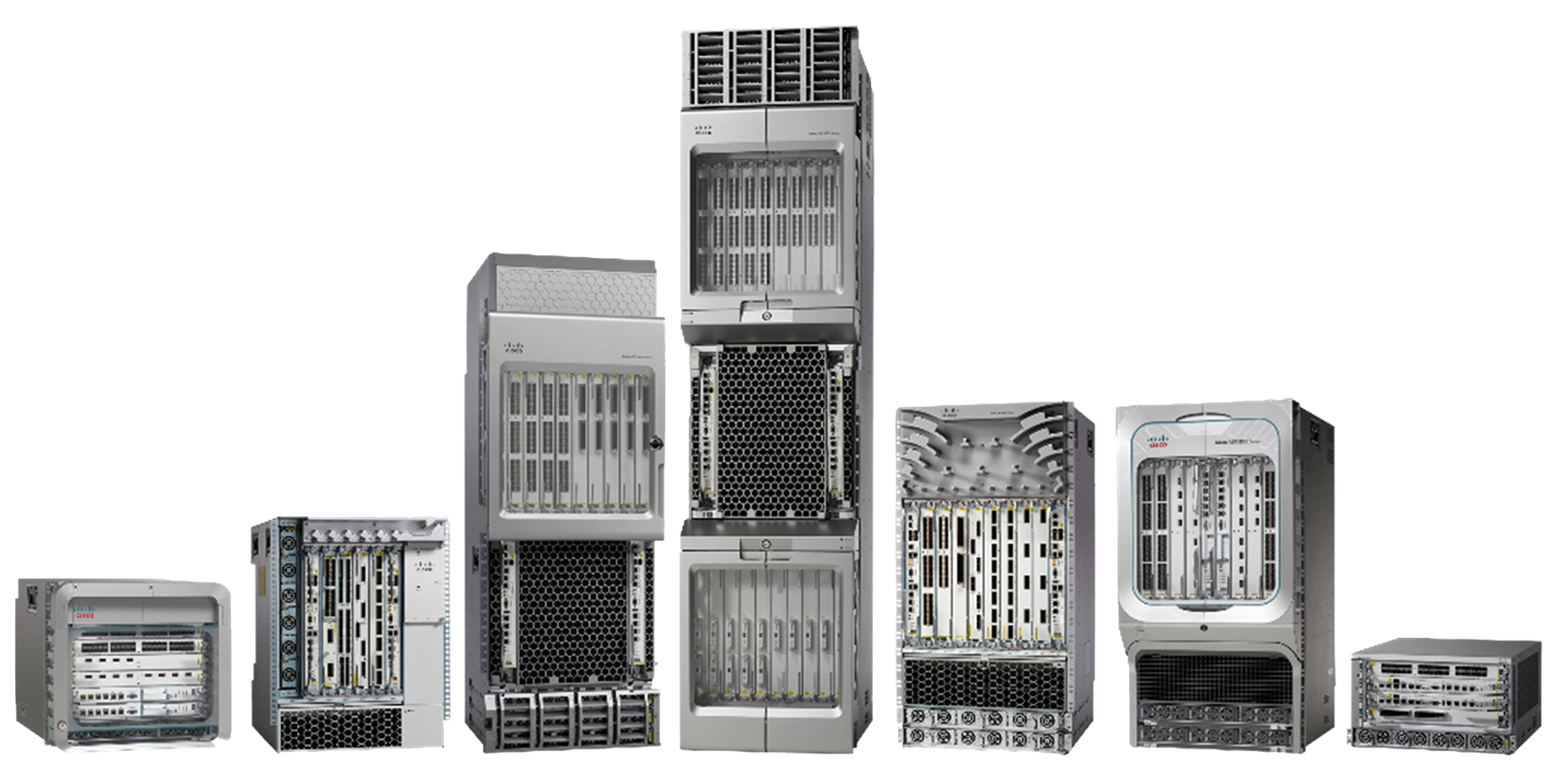
Cisco ASR 9000 Series Modular Chassis
The Cisco ASR 9000 Series is an operationally simple, future-optimized platform using next-generation hardware and software. The following are highlights of this next-generation platform:
● Fully distributed system: The Cisco ASR 9000 Series operates in a fully distributed fashion; all packet-forwarding decisions and actions take place on the individual line cards. These high-density Ethernet line cards are equipped with a specialized network processor that provides a flexible programming infrastructure with high-density Hierarchical Quality-of-Service (H-QoS) services, security, and advanced timing capabilities, with PTP and Synchronous Ethernet (SyncE) support. The distributed nature of the Cisco ASR 9000 Series improves resiliency by adding a new dimension in scale for features such as Bidirectional Forwarding Detection (BFD) and Ethernet Operations, Administration, and Maintenance (EOAM).
● Operationally efficient and redundant hardware: The Cisco ASR 9000 Series provides an infrastructure where all common components, Route Switch Processors (RSPs), Route Processors (RPs), switching fabric, fans and power supplies are redundant. In addition, the platform is designed to use power on an as-needed basis, depending on system requirements. Power has been modularized for a true pay-as-you-grow approach, reducing Capital Expenditures (CapEx) and providing an operationally efficient deployment. Cisco ASR 9000 Series also provides advanced power management to control power utilization. The Cisco ASR 9000 Series also provides space-optimized, high capacity compact-platform options.
● Environmentally conscious design: In today’s world of increasing awareness of human impact on the environment and the resultant fiscal implications, Cisco ASR 9000 Series Routers bring a fresh new “conscious” approach to product development. From optimal thermal design to the architecture of the power infrastructure, from the placement of line-card components to the pitch of each slot, every design aspect has one goal in mind: reduced environmental impact through lowered power consumption and decreased cooling requirements. Even the product packaging process was evaluated to minimize the use of packaging material and thereby reduce waste at customer locations. The Cisco ASR 9000 Series is an example of the continued Cisco commitment to efficient and future-friendly product design.
● Cisco IOS XR Software modular operating system: The Cisco ASR 9000 Series uses the Cisco IOS XR operating system, which provides high quality, ultra-scale and rich features. The Cisco IOS XR operating system uses a microkernel architecture to achieve true modularity. This modularity provides the path to nonstop operations during software image upgrades or module changes, without affecting normal platform functionality.
● Optimized for IPv6: Cisco is delivering on our strategy of building out IPv6 next-generation networks to simplify design, deployment, and management of services for global service providers.
The Cisco ASR 9000 Series offers advanced switching capacity, optimized power consumption and cooling, high-availability design, and a modular operating system to significantly lower the Total Cost of Ownership (TCO) for service providers.
Solving the challenges of tomorrow, today
The Cisco ASR 9000 Series is built on the premise of addressing the challenges that service providers face when deploying current networks and planning for the networks of tomorrow:
● Power-efficient deployments: The Cisco ASR 9000 Series has a significantly improved energy-efficient design thanks to its low Watt/Gbps ratio. This amazing breakthrough ultimately translates to lower power costs, lower carbon footprint, and the ability to serve more customers and deliver more services in less rack space.
● Increasing Average Revenue Per User (ARPU): Service providers may increase the price models of existing services or increase the service offerings per user. Although traditional service prices continue to decline, the Cisco ASR 9000 Series helps establish a new financial reality by facilitating reliable and scalable next-generation converged service edge and advanced Carrier Ethernet service offerings.
● Managing services simply and efficiently: The Cisco ASR 9000 Series provides leading-edge network, device, and service management through a full complement of management solutions called Crosswork Network Automation. Cisco Crosswork Network Automation is a closed-loop, outcome-driven software suite used to deliver efficient mass-scale network operations across the services lifecycle. This is a scalable solution for operators of all-sized networks to accelerate mean-time-to-value by monetizing agile new services and minimizing mean-time-to-remediation to proactively prevent customer impacting issues. Combining these elements with a comprehensive set of Ethernet, Multiprotocol Label Switching (MPLS) and Segment Routing Operations, Administration, and Maintenance (OAM) capabilities, the Cisco ASR 9000 Series provides an operator-friendly environment.
● Network convergence: A common objective among service providers is to migrate their networks to a single, converged infrastructure that supports all services. This goal is compelling because it ultimately results in decreased CapEx and Operating Expenses (OpEx) because of a reduction in network elements. The Cisco ASR 9000 Series is a critical component in optimizing service-transport infrastructure because of its service flexibility, comprehensive feature set, wide interface capability, and transparent integration of Carrier Ethernet and WAN interfaces as the foundation for services delivery. The Cisco ASR 9000 Series provides a powerful single solution to the providers’ MultiService Edge (MSE), Ethernet-optimized MSE (E-MSE), and Carrier Ethernet needs.
● Meeting tomorrow’s service requirements: Designed into the Cisco ASR 9000 Series are critical capabilities supporting the services of tomorrow. Providing increased bandwidth capabilities for network devices at economically viable prices is one of the primary criteria for true carrier transport platforms. The Cisco ASR 9000 Series can scale to unprecedented levels, providing the ideal foundation for a full suite of next-generation services. Another crucial component for true network and service convergence is the integration of service intelligence in network elements. The Cisco ASR 9000 Series is designed to offer advanced subscriber management using silicon-based security services.
The Cisco ASR 9000 Series Aggregation Services Routers provide unsurpassed speeds, up through 400 Gigabit Ethernet, with scale and high density. The Cisco ASR 9000 and ASR 9900 Series Routers provide flexible options for high density 1 Gigabit Ethernet, 10 Gigabit Ethernet, 25 Gigabit Ethernet, 40 Gigabit Ethernet, 100 Gigabit Ethernet and 400 Gigabit Ethernet ports without the need for a complete chassis replacement. These line cards, offered in base and extended-scale configurations, are complemented by the nonblocking fabric (on the RSP for the Cisco ASR 9006, ASR 9010, ASR 9906, ASR 9910 and ASR 9904 Routers and on separate fabric cards for the Cisco ASR 9906, ASR 9910, ASR 9912 and ASR 9922 Routers), and by the innovative backplane, thermal, and power infrastructure on the chassis.
The Cisco ASR 9000 Series has a modular power architecture available in both AC and DC. The power supplies are housed in field-serviceable Power Entry Modules (PEMs), which also come in AC and DC forms. Each PEM can hold up to three or four modules depending on its corresponding type, with no power zones or placement restrictions (mixing of AC and DC supplies is not supported). Service providers can add more power as their bandwidth and feature requirements increase over time, by adding more line cards to the chassis. This capability translates to lower CapEx initially and optimal OpEx over the product life.
The Cisco ASR 9000 Series also features a fully integrated timing infrastructure, allowing the routers to take in timing inputs (for example, SyncE, GPS, Building Integrated Timing Supply [BITS], and DOCSIS® Timing Interface [DTI]) and distribute them over the backplane to each slot. This capability allows extensive support for transparent mobile convergence, mobile Radio Access Network (RAN) backhaul, and Time-Division Multiplexing (TDM) circuit emulation, without sacrificing performance or scale.
The optimized thermal infrastructure of the Cisco ASR 9000 Series is designed to be scalable to support future capacity requirements. Variable-speed high-efficiency fans provide reduced power requirements under normal operating environments while retaining the capability to cool current and future line cards under extreme conditions.
Table 1 lists the chassis hardware available for the Cisco ASR 9000 and ASR 9900 Series.
Table 1. Hardware Available for Cisco ASR 9000 and ASR 9900 Series
| Product Description |
Product Number |
| Cisco ASR 9000 and ASR 9900 Series Chassis |
|
| Cisco ASR 9010 chassis |
ASR-9010-AC-V2 ASR-9010-DC-V2 ASR-9010-SYS |
| Cisco ASR 9006 chassis |
ASR-9006-AC-V2 ASR-9006-DC-V2 ASR-9006-SYS |
| Cisco ASR 9922 chassis |
ASR-9922-AC ASR-9922-DC ASR-9922 |
| Cisco ASR 9912 chassis |
ASR-9912-AC ASR-9912-DC ASR-9912 |
| Cisco ASR 9910 chassis |
ASR-9910 |
| Cisco ASR 9906 chassis |
ASR-9906 |
| Cisco ASR 9904 chassis |
ASR-9904-AC ASR-9904-DC ASR-9904 |
| Cisco ASR 9000 Series Power Infrastructure |
|
| AC power supply, 6000W |
PWR-6KW-AC-V3 PWR-6KW-AC-V3= |
| AC power entry module V3 |
A9K-AC-PEM-V3 A9K-AC-PEM-V3= |
| AC power supply, 3000W |
PWR-3KW-AC-V2 PWR-3KW-AC-V2= |
| AC power entry module V2 |
ASR9K-AC-PEM-V2 A9K-AC-PEM-V2= |
| DC power supply, 4400W |
PWR-4.4KW-DC-V3 PWR-4.4KW-DC-V3= |
| DC power entry module V3 |
A9K-DC-PEM-V3 A9K-DC-PEM-V3= |
| DC power supply, 2100W |
PWR-2KW-DC-V2 PWR-2KW-DC-V2= |
| DC power entry module V2 |
ASR9K-DC-PEM-V2 A9K-DC-PEM-V2= |
| Cisco ASR 9000 Series Thermal Infrastructure |
|
| Cisco ASR 9010 fan, 2 fan trays per chassis |
ASR-9010-FAN ASR-9010-FAN-V2 |
| Cisco ASR 9006 fan, 2 fan trays per chassis |
ASR-9006-FAN ASR-9006-FAN-V2 |
| Cisco ASR 9922 fan, 4 fan trays per chassis |
ASR-9922-FAN ASR-9922-FAN-V2 ASR-9922-FAN-V3 |
| Cisco ASR 9912 fan, 2 fan trays per chassis |
ASR-9912-FAN A9K-9912-FAN |
| Cisco ASR 9910 fan, 2 fan trays per chassis |
ASR-9910-FAN |
| Cisco ASR 9906 fan, 2 fan trays per chassis |
ASR-9906-FAN |
| Cisco ASR 9904 fan, 1 fan tray per chassis |
ASR-9904-FAN A9K-9904-FAN |
| Cisco ASR 9010 fan filter, 1 per chassis |
ASR-9010-FILTER |
| Cisco ASR 9006 fan filter, 1 per chassis |
ASR-9006-FILTER |
| Cisco ASR 9922 fan filter, 1 center and 2 side filters per chassis |
ASR-9922-FLTR-CEN ASR-9922-FLTR-CV2 ASR-9922-FLTR-LR |
| Cisco ASR 9912 fan filter, 1 center and 2 side filters per chassis |
ASR-9912-FLTR-CEN ASR-9900-FLTR-LR |
| Cisco ASR 9910 fan filter, 1 per chassis |
ASR-9910-FILTER |
| Cisco ASR 9906 fan filter, 1 per chassis |
ASR-9906-FILTER |
| Cisco ASR 9904 fan filter, 1 per chassis |
ASR-9904-FILTER |
More details about the individual Cisco ASR 9000 Series components, such as the RSPs, the Ethernet line cards, Modular Port Adapters (MPA), Shared Port Adapters (SPA) and SPA Interface Processors (SIP) are available in the respective data sheets at: Cisco ASR 9000 Series Data Sheet Listing.
Cisco ASR 9000 Series routers deliver exceptional scale, service flexibility, high availability, and operational simplicity. The routers are powered by Cisco IOS XR Software, an innovative self-healing, distributed operating system designed for always-on operation while scaling system capacity up to 160 Tbps. Cisco IOS XR Software also allows for an end-to-end IP/MPLS solution to service provider requirements based on the same software, thereby reducing the operational complexity of managing multiple operating systems. Cisco IOS XR Software Release 3.7.2 introduced support for the Cisco ASR 9000 Series Routers, which are designed to address the Carrier Ethernet foundation for visual networking. The Cisco ASR 9000 Series further enhances the IP Next-Generation Network (IP NGN) Carrier Ethernet design for converged, resilient, intelligent, and scalable transport of consumer, business, wholesale, and mobile services.
Cisco ASR 9000 Series Carrier Ethernet applications include business services such as Layer 2 VPN (L2VPN) and L3VPN, Internet Protocol Television (IPTV), Content-Delivery Networks (CDNs), and mobile backhaul transport networks. Features supported include Ethernet services; SR, SRv6, EVPN, VxLAN, L2VPN; IPv4, IPv6, and L3VPN; Layer 2 and Layer 3 Multicast; IP over Dense Wavelength-Division Multiplexing (IPoDWDM); SyncE; EOAM and MPLS OAM; Layer 2 and Layer 3 Access Control Lists (ACLs); H-QoS; MPLS Traffic Engineering Fast Reroute (MPLS TE-FRR); Multichassis Link Aggregation (MC-LAG); Integrated Routing and Bridging (IRB); and Cisco Nonstop Forwarding (NSF) and Nonstop Routing (NSR).
For more information about the Cisco ASR 9000 Series IOS-XR software features supported, visit: Cisco ASR 9000 Series Product Bulletins.
Table 2 provides details about the Cisco ASR 9006 and ASR 9010. Table 3 provides details about the Cisco ASR 9904. Table 4 provides details about the Cisco ASR 9906 and 9910. Table 5 provides details about the Cisco ASR 9912 and ASR 9922. All of these systems are designed to the same high standards of performance and reliability; they feature the same power and thermal innovations; and they can share the line cards, PEMs, and power supplies for maximum flexibility in your network planning. The RSPs can be shared between the Cisco ASR 9010, ASR 9006, ASR 9910 and ASR 9906 and ASR 9904 chassis; the Cisco ASR 9922 and ASR 9912 chassis come with their own route processors and up to seven fabric cards. The Cisco ASR 9910 and ASR 9906 each come with their own chassis specific five fabric cards.
Table 2. Cisco ASR 9006 and ASR 9010[1]
| Specification |
Model |
|
| Cisco ASR 9006 |
Cisco ASR 9010 |
|
| Categories |
||
| Physical specifications |
Height: 17.50 in. (444.5 mm) (10 RU) Width: 17.38 in. (441.45 mm) Depth:
● With doors: 29.05 in. (737.9 mm)
● Without doors: 29.05 in. (737.9 mm)
Weight:
● 89.55 lb (40.7 kg) (chassis with PEM)
● 150 lb (65.91 kg) (fully loaded, excluding line cards and power modules) – RSP, two v2 FAN trays, PEMs
|
Height: 36.75 in. (933.45 mm) (21 RU) Width: 17.38 in. (441.45 mm) Depth:
● With doors: 29.03 in. (737.4 mm)
● Without doors: 28.24 in. (717.3 mm)
Weight:
● 155.6 lb (70.73 kg) (chassis with PEM)
● 231.6 lb (105.27 kg) (fully loaded, excluding line cards and power modules) – RSP, two v2 fan trays, PEMs
|
| Slot orientation |
Horizontal |
Vertical |
| Cisco ASR 9000 Series RSP |
Dual redundant RSPs with integrated fabric in 2 slots |
Dual redundant RSPs with integrated fabric in 2 slots |
| Cisco ASR 9000 Series line cards |
4 line-card slots |
8 line-card slots |
| “Commons” components |
2 RSPs 2 fan trays 1 PEM (either DC or AC) 1 fan filter |
2 RSPs 2 fan trays 2 PEMs (either DC or AC) 1 fan filter |
| Reliability and availability |
Fabric redundancy Fan redundancy Feed redundancy Power-supply redundancy RSP redundancy Software redundancy |
Fabric redundancy Fan redundancy Feed redundancy Power-supply redundancy RSP redundancy Software redundancy |
| Rack mounting |
19-in. default 21- and 23-in. adapters available Note: Minimum 17.75-in. opening between posts is needed for proper operation |
19-in. default 21- and 23-in. adapters available Note: Minimum 17.75-in. opening between posts is needed for proper operation |
| Cabinet mounting |
Yes Note: Doors not recommended in enclosed cabinets |
Yes Note: Doors not recommended in enclosed cabinets |
| Wall mounting |
No |
No |
| Airflow |
Right-to-back, Front-to-back with baffle |
Front-to-back |
| Performance |
||
| Fabric |
One per RSP:
● Active/active nonblocking operation mode in dual-RSP redundant configuration
● Fully redundant in dual-RSP redundant configuration
● Built-in service-intelligence and traffic-prioritization capability
|
One per RSP:
● Active/active nonblocking operation mode in dual-RSP redundant configuration
● Fully redundant in dual-RSP redundant configuration
● Built-in service-intelligence and traffic-prioritization capability
|
| Thermal |
Two fan trays:
● 6 high-efficiency fans per tray
● Variable-speed fans for optimal thermal performance
● No single point of failure
|
Two fan trays:
● 12 high-efficiency fans per tray
● Variable-speed fans for optimal thermal performance
● No single point of failure
|
| Power |
||
| Modularity |
Pay-as-you-grow power for future scalability, available in AC and DC. Multiple power module types:
● 3 kW AC power module
● 2.1 kW DC power module
Note: Mixing of AC and DC modules is not supported |
Pay-as-you-grow power for future scalability, available in AC and DC. Multiple power module types:
● 6 kW and 3 kW AC power modules
● 4.4 kW and 2.1 kW DC power modules
Note: Mixing of AC and DC modules is not supported |
| Redundancy |
● AC: N+N redundancy
● DC: N+1 redundancy
● Power module redundancy
● A/B Feed redundancy
|
● AC: N+N redundancy
● DC: N+1 redundancy
● Power module redundancy
● A/B Feed redundancy
● PEM redundancy
|
| Power zones |
No power zone restrictions Fully load-sharing power infrastructure |
No power zone restrictions Fully load-sharing power infrastructure |
| Power input |
Worldwide ranging AC (200-240V; 50-60 Hz; 16A maximum) Worldwide ranging DC (-40 to -72V; 50A nominal, 60A maximum) |
Worldwide ranging AC (200-240V; 50-60 Hz; 16A maximum) Worldwide ranging DC (-40 to -72V; 50A nominal, 60A maximum) |
| Power-module airflow |
Front-to-back |
Front-to-back |
| Environmental Specifications (All Entries Applicable to Cisco ASR 9006 and ASR 9010) |
||
| Operating temperature (nominal) |
41 to 104°F (5 to 40°C) |
|
| Operating temperature (short-term)[2] |
ASR 9006: 23 to 131°F (-5 to 55°C) ASR 9010: 23 to 122°F (-5 to 50°C) |
|
| Operating humidity (nominal) (relative humidity) |
5 to 90% |
|
| Storage temperature |
-40 to 158°F (-40 to 70°C) |
|
| Storage (relative humidity) |
5 to 93% |
|
| Operating altitude |
-60 to 4000m (up to 2000m conforms to IEC/EN/UL/CSA 60950 requirements) |
|
| Regulatory Compliance (All Entries Applicable to Cisco ASR 9006 and ASR 9010) |
||
| Network Equipment Building Standards (NEBS) |
Cisco ASR 9006 and ASR 9010 Routers are designed to meet:
● SR-3580: NEBS Criteria Levels (Level 3)
● GR-1089-CORE: NEBS EMC and Safety
● GR-63-CORE: NEBS Physical Protection
● VZ.TPR.9205: Verizon TEEER
|
|
| ETSI standards |
Cisco ASR 9006 and ASR 9010 Routers are designed to meet:
● EN300 386: Telecommunications Network Equipment (EMC)
● ETSI 300 019 Storage Class 1.1
● ETSI 300 019 Transportation Class 2.3
● ETSI 300 019 Stationary Use Class 3.1
|
|
| EMC standards emission |
Cisco ASR 9006 and ASR 9010 Routers are designed to meet:
● FCC Class 47CFR15 A
● ICES 003 Class A
● AS/NZS CISRP22 Class A
● CISPR 22 (EN55022) Class A
● VCCI Class A
● BSMI Class A
● IEC/EN 61000-3-12: Power Line Harmonics
● IEC/EN 61000-3-11: Voltage Fluctuations and Flicker
● EN55022: Information Technology Equipment (Emissions)
● EN 50121-4: Railway EMC
|
|
| EMC standards immunity |
Cisco ASR 9006 and ASR 9010 Routers are designed to meet:
● IEC/EN-61000-4-2: Electrostatic Discharge Immunity (8kV Contact, 15kV Air)
● IEC/EN-61000-4-3: Radiated Immunity (10V/m)
● IEC/EN-61000-4-4: Electrical Fast Transient Immunity (2kV Power, 1kV Signal)
● IEC/EN-61000-4-5: Surge AC Port (4kV CM, 2kV DM)
● IEC/EN-61000-4-5: Signal Surge Ports (1kV)
● IEC/EN-61000-4-5: Surge DC Port (1kV CM, 1kV DM)
● IEC/EN-61000-4-6: Immunity to Conducted Disturbances (10Vrms)
● IEC/EN-61000-4-8: Power Frequency Magnetic Field Immunity (30A/m)
● IEC/EN-61000-4-11: Voltage DIPS, Short Interruptions, and Voltage Variations
● EN55024: Information Technology Equipment (Immunity)
● EN50082-1/EN-61000-6-1: Generic Immunity Standard
● EN 50121-4: Railway EMC
|
|
| Safety |
Cisco ASR 9006 and ASR 9010 Routers are designed to meet:
● UL/CSA/IEC/EN 60950-1
● IEC/EN 60825 Laser Safety
● ACA TS001
● AS/NZS 60950
● FDA Code of Federal Regulations Laser Safety
|
|
Table 3. Cisco ASR 9904[3]
| Specification |
Model |
| Cisco ASR 9904 |
|
| Categories |
|
| Physical specifications |
Height: 10.38 in. (263.65x mm) (6 RU) Width: 17.57 in. (446.28 mm) Depth: 25.02 in. (635.51 mm) Weight:
● 62 lb (28.2 kg) (V2 PEM AND chassis)
● 114.05 lb (51.84 kg) (2 RSP, Fan Tray, PEM)
|
| Slot orientation |
Horizontal |
| Cisco ASR 9000 Series RSP |
Dual redundant RSPs with integrated fabric in 2 slots |
| Fabric |
- |
| Cisco ASR 9000 Series line cards |
2 line-card slots |
| “Commons” components |
2 RSPs 1 fan tray 1 PEM (either DC or AC) 1 fan filter |
| Reliability and availability |
Fabric redundancy Feed redundancy Power-supply redundancy Route processor redundancy Software redundancy |
| Rack mounting |
19-in. 21- and 23-in. adapters available Note: Minimum 17.75-in. opening between posts is needed for proper operation. |
| Cabinet mounting |
Yes |
| Wall mounting |
No |
| Airflow |
Right-to-left, front-to-back with baffle |
| Performance |
|
| Fabric |
One per RSP:
● Active/active nonblocking operation mode in dual-RSP redundant configuration
● Fully redundant in dual-RSP redundant configuration
● Built-in service-intelligence and traffic-prioritization capability
|
| Thermal |
One fan tray:
● 12 high-efficiency fans per tray
● Variable-speed fans for optimal thermal performance
|
| Power |
|
| Modularity |
Pay-as-you-grow power for future scalability, available in AC and DC. Multiple power module types:
● 3 kW AC power module
● 2.1 kW DC power module
Note: Mixing of AC and DC modules is not supported |
| Redundancy |
● AC: N+N redundancy
● DC: N+1 redundancy
● Power module redundancy
● A/B Feed redundancy
|
| Power zones |
No power zone restrictions Fully load-sharing power infrastructure |
| Power input |
Worldwide ranging AC (200-240V; 50-60 Hz; 16A maximum) Worldwide ranging DC (-40 to -72V; 50A nominal, 60A maximum) |
| Power module airflow |
Front-to-back |
| Environmental Specifications |
|
| Operating temperature (nominal) |
41 to 104°F (5 to 40°C) |
| Operating temperature (short‑term)[4] |
23 to 131°F (-5 to 55°C) for ASR 9904 23 to 122°F (-5 to 50°C) for ASR 9910 |
| Operating humidity (nominal) (relative humidity) |
5 to 90% |
| Storage temperature |
-40 to 158°F (-40 to 70°C) |
| Storage (relative humidity) |
5 to 93% |
| Operating altitude |
-60 to 4000m (up to 2000m conforms to IEC/EN/UL/CSA 60950 requirements) |
| Regulatory Compliance |
|
| Network Equipment Building Standards (NEBS) |
The Cisco ASR 9904 Router is designed to meet (qualification in progress):
● SR-3580: NEBS Criteria Levels (Level 3)
● GR-1089-CORE: NEBS EMC and Safety
● GR-63-CORE: NEBS Physical Protection
● VZ.TPR.9205: Verizon TEEER
|
| ETSI standards |
The Cisco ASR 9904 Router is designed to meet (qualification in progress):
● EN300 386: Telecommunications Network Equipment (EMC)
● ETSI 300 019 Storage Class 1.1
● ETSI 300 019 Transportation Class 2.3
● ETSI 300 019 Stationary Use Class 3.1
|
| EMC standards emission |
The Cisco ASR 9904 Router is designed to meet:
● FCC Class 47CFR15 A
● ICES 003 Class A
● AS/NZS CISRP22 Class A
● CISPR 22 (EN55022) Class A
● VCCI Class A
● BSMI Class A
● IEC/EN 61000-3-12: Power Line Harmonics
● IEC/EN 61000-3-11: Voltage Fluctuations and Flicker
● EN55022: Information Technology Equipment (Emissions)
● EN 50121-4: Railway EMC
|
| EMC standards immunity |
The Cisco ASR 9904 Router is designed to meet:
● IEC/EN-61000-4-2: Electrostatic Discharge Immunity (8kV Contact, 15kV Air)
● IEC/EN-61000-4-3: Radiated Immunity (10V/m)
● IEC/EN-61000-4-4: Electrical Fast Transient Immunity (2kV Power, 1kV Signal)
● IEC/EN-61000-4-5: Surge AC Port (4kV CM, 2kV DM)
● IEC/EN-61000-4-5: Signal Surge Ports (1kV)
● IEC/EN-61000-4-5: Surge DC Port (1kV CM, 1kV DM)
● IEC/EN-61000-4-6: Immunity to Conducted Disturbances (10Vrms)
● IEC/EN-61000-4-8: Power Frequency Magnetic Field Immunity (30A/m)
● IEC/EN-61000-4-11: Voltage DIPS, Short Interruptions, and Voltage Variations
● EN55024: Information Technology Equipment (Immunity)
● EN50082-1/EN-61000-6-1: Generic Immunity Standard
● EN 50121-4: Railway EMC
|
| Safety |
The Cisco ASR 9904 Router is designed to meet:
● UL/CSA/IEC/EN 60950-1
● IEC/EN 60825 Laser Safety
● ACA TS001
● AS/NZS 60950
● FDA Code of Federal Regulations Laser Safety
|
Table 4. Cisco ASR 9906 and ASR 9910[5]
| Specification |
Model |
|
| Cisco ASR 9906 |
Cisco ASR 9910 |
|
| Categories |
||
| Physical specifications |
Height: 24.39 in.(619.50mm) (14RU) Width: 17.60 in. (447.04 mm) Depth: 31.45 in. (798.83 mm) Weight:
● 131.5 lb (59.65 kg) (Chassis with 1 PEM)
● 212.5 lb (96.4 kg) (2 Fan Trays, 2 RSP, 5 Fabric Cards, 1 PEM)
|
Height: 36.69 in.(931.9mm) (21RU) Width: 17.60 in. (447.04 mm) Depth:
● With Air Reflector: 39.63 in. (1006.6mm)
● Without Air Reflector: 30.41 in. (772.4mm)
Weight:
● 170 lb (77.27 kg) (Chassis with 2 PEMs)
● 302.25 lb (137.38 kg) (2 Fan Trays, 2 RSP, 5 Fabric Cards, 2 PEMs)
|
| Slot orientation |
Vertical |
Vertical |
| Cisco ASR 9000 Series RSP |
Dual redundant RSPs with integrated fabric in 2 slots |
Dual redundant RSPs with integrated fabric in 2 slots |
| Fabric |
6 + 1 redundant fabrics (2 located on the RSP, 5 on dedicated switch fabric cards) |
6 + 1 redundant fabrics (2 located on the RSP, 5 on dedicated switch fabric cards) |
| Cisco ASR 9000 Series line cards |
4 line-card slots |
8 line-card slots |
| “Commons” components |
2 RSPs 5 fabric cards 2 fan trays 1 PEM (either DC or AC) 1 fan filter |
2 RSPs 5 fabric cards 2 fan trays 2 PEMs (either DC or AC) 1 fan filter |
| Reliability and availability |
Fabric redundancy Fan redundancy Feed redundancy Power-supply redundancy Route processor redundancy Software redundancy |
Fabric redundancy Fan redundancy Feed redundancy Power-supply redundancy Route processor redundancy Software redundancy |
| Rack mounting |
19-in. 21- and 23-in. adapters available Slide rails available for 4 post racks |
19-in. 21- and 23-in. adapters available Slide rails available for 4 post racks |
| Cabinet mounting |
Yes |
Yes |
| Wall mounting |
No |
No |
| Airflow |
Front-to-back |
Front-to-back |
| Performance |
||
| Fabric |
One per RSP and five dedicated switch fabric card slots:
● Support for 6 + 1 redundancy
● Operate in active/active nonblocking mode
● Built-in service-intelligence and traffic-prioritization capability
|
One per RSP and five dedicated switch fabric card slots:
● Support for 6 + 1 redundancy
● Operate in active/active nonblocking mode
● Built-in service-intelligence and traffic-prioritization capability
|
| Thermal |
Two fan trays:
● 7 high-efficiency fans per tray
● Variable-speed fans for optimal thermal performance
● No single point of failure
|
Two fan trays:
● 12 high-efficiency fans per tray
● Variable-speed fans for optimal thermal performance
● No single point of failure
|
| Power |
||
| Modularity |
Pay-as-you-grow power for future scalability, available in AC and DC. Multiple power module types:
● 6 kW AC power modules
● 4.4 kW DC power modules
Note: Mixing of AC and DC modules is not supported |
Pay-as-you-grow power for future scalability, available in AC and DC. Multiple power module types:
● 6 kW AC power modules
● 4.4 kW DC power modules
Note: Mixing of AC and DC modules is not supported |
| Redundancy |
● AC: N+N redundancy
● DC: N+1 redundancy
● Power module redundancy
● A/B Feed redundancy
● PEM redundancy
|
● AC: N+N redundancy
● DC: N+1 redundancy
● Power module redundancy
● A/B Feed redundancy
● PEM redundancy
|
| Power zones |
No power zone restrictions Fully load-sharing power infrastructure |
No power zone restrictions Fully load-sharing power infrastructure |
| Power input |
Worldwide ranging AC (200-240V; 50-60 Hz; 16A maximum) Worldwide ranging DC (-40 to -72V; 50A nominal, 60A maximum) |
Worldwide ranging AC (200-240V; 50-60 Hz; 16A maximum) Worldwide ranging DC (-40 to -72V; 50A nominal, 60A maximum) |
| Power module airflow |
Front-to-back |
Front-to-back |
| Environmental Specifications (All Entries Applicable to Cisco ASR 9906 and ASR 9910) |
||
| Operating temperature (nominal) |
41 to 104°F (5 to 40°C) |
|
| Operating temperature (short‑term)[6] |
23 to 131°F (-5 to 55°C) for ASR 9906 23 to 122°F (-5 to 50°C) for ASR 9910 |
|
| Operating humidity (nominal) (relative humidity) |
5 to 90% |
|
| Storage temperature |
-40 to 158°F (-40 to 70°C) |
|
| Storage (relative humidity) |
5 to 93% |
|
| Operating altitude |
-60 to 4000m (up to 2000m conforms to IEC/EN/UL/CSA 60950 requirements) |
|
| Regulatory Compliance (All Entries Applicable to Cisco ASR 9906 and ASR 9910) |
||
| Network Equipment Building Standards (NEBS) |
Cisco ASR 9906 and ASR 9910 Routers are designed to meet:
● SR-3580: NEBS Criteria Levels (Level 3)
● GR-1089-CORE: NEBS EMC and Safety
● GR-63-CORE: NEBS Physical Protection
● VZ.TPR.9205: Verizon TEEER
|
|
| ETSI standards |
Cisco ASR 9906 and ASR 9910 Routers are designed to meet (qualification in progress):
● EN300 386: Telecommunications Network Equipment (EMC)
● ETSI 300 019 Storage Class 1.1
● ETSI 300 019 Transportation Class 2.3
● ETSI 300 019 Stationary Use Class 3.1
|
|
| EMC standards emission |
Cisco ASR 9906 and ASR 9910 Routers are designed to meet:
● FCC Class 47CFR15 A
● ICES 003 Class A
● AS/NZS CISRP22 Class A
● CISPR 22 (EN55022) Class A
● VCCI Class A
● BSMI Class A
● IEC/EN 61000-3-12: Power Line Harmonics
● IEC/EN 61000-3-11: Voltage Fluctuations and Flicker
● EN55022: Information Technology Equipment (Emissions)
● EN 50121-4: Railway EMC
|
|
| EMC standards immunity |
Cisco ASR 9906 and ASR 9910 Routers are designed to meet:
● IEC/EN-61000-4-2: Electrostatic Discharge Immunity (8kV Contact, 15kV Air)
● IEC/EN-61000-4-3: Radiated Immunity (10V/m)
● IEC/EN-61000-4-4: Electrical Fast Transient Immunity (2kV Power, 1kV Signal)
● IEC/EN-61000-4-5: Surge AC Port (4kV CM, 2kV DM)
● IEC/EN-61000-4-5: Signal Surge Ports (1kV)
● IEC/EN-61000-4-5: Surge DC Port (1kV CM, 1kV DM)
● IEC/EN-61000-4-6: Immunity to Conducted Disturbances (10Vrms)
● IEC/EN-61000-4-8: Power Frequency Magnetic Field Immunity (30A/m)
● IEC/EN-61000-4-11: Voltage DIPS, Short Interruptions, and Voltage Variations
● EN55024: Information Technology Equipment (Immunity)
● EN50082-1/EN-61000-6-1: Generic Immunity Standard
● EN 50121-4: Railway EMC
|
|
| Safety |
Cisco ASR 9906 and ASR 9910 Routers are designed to meet:
● UL/CSA/IEC/EN 60950-1
● IEC/EN 60825 Laser Safety
● ACA TS001
● AS/NZS 60950
● FDA Code of Federal Regulations Laser Safety
|
|
Table 5. Cisco ASR 9912 and ASR 9922[7]
| Specification |
Model |
|
| Cisco ASR 9912 |
Cisco ASR 9922 |
|
| Categories |
||
| Physical specifications |
Height: 52.5 in. (1333.5 mm) (30 RU) Width: 17.60 in. (447.04 mm) Depth:
● With door: 30.03 in. (762.76 mm)
● Without doors: 29.25 in. (742.95mm)
Weight:
● 231.25 lb (105.11 kg) (3 PEMs and chassis)
● 389.55 lb (177.07 kg) (3 PEMs, 2 Fan Trays, 2 RP2, and 5 Fabric Card 2)
|
Height: 77 in. (1955.4 mm) (44 RU) Width: 17.60 in. (447.04 mm) Depth:
● With doors: 30.68 in. (779.27 mm)
● Without doors: 30.19 in. (766.82 mm)
Weight:
● 413 lb (187.73 kg) (4 PEM and chassis)
● 639.5 lb (290.7 kg) (2 RP2, 7 Fabric Cards 2, 4 Fan Trays, and 4 PEMs)
|
| Slot orientation |
Vertical |
Vertical |
| Cisco ASR 9000 Series RSP |
RSPs segregated into route processor and fabric cards |
RSPs segregated into route processor and fabric cards |
| Route processor |
Dual redundant route processors in 2 slots |
Dual redundant route processors in 2 slots |
| Fabric cards |
6 + 1 redundant fabric cards |
6 + 1 redundant fabric cards |
| Cisco ASR 9000 Series line cards |
10 line-card slots |
20 line-card slots |
| “Commons” components |
2 route processors 7 fabric cards 2 fan trays 3 PEMs (either DC or AC) 1 center fan filter, 2 side fan filters |
2 route processors 7 fabric cards 4 fan trays 4 PEMs (either DC or AC) 1 center fan filter, 2 side fan filters |
| Reliability and availability |
Fabric redundancy Fan redundancy Feed redundancy Power-supply redundancy Route-processor redundancy Software redundancy |
Fabric redundancy Fan redundancy Feed redundancy Power-supply redundancy Route-processor redundancy Software redundancy |
| Rack mounting |
19-in. 21- and 23-in. adapters available |
19-in. 21- and 23-in. adapters available |
| Cabinet mounting |
Yes Note: Doors not recommended in enclosed cabinets |
Yes Note: Doors not recommended in enclosed cabinets |
| Wall mounting |
No |
No |
| Airflow |
Front-to-back |
Front-to-back |
| Performance |
||
| Fabric |
Seven switch fabric card slots:
● Support for 6 + 1 redundancy
● Operate in active/active nonblocking mode
● Built-in service-intelligence and traffic-prioritization capability
|
Seven switch fabric card slots:
● Supports 6 + 1 redundancy
● Operate in active/active nonblocking mode
● Built-in service-intelligence and traffic-prioritization capability
|
| Thermal |
Two fan trays:
● 12 high-efficiency fans per tray
● Variable-speed fans for optimal thermal performance
● No single point of failure
|
Four fan trays:
● 12 high-efficiency fans per tray
● Variable-speed fans for optimal thermal performance
● No single point of failure
|
| Power |
||
| Modularity |
Pay-as-you-grow power for future scalability, available in AC and DC Multiple power module types:
● 6 kW and 3 kW AC power modules
● 4.4 kW and 2.1 kW DC power modules
Note: Mixing of AC and DC modules is not supported |
Pay-as-you-grow power for future scalability, available in AC and DC Multiple power module types:
● 6 kW and 3 kW AC power modules
● 4.4 kW and 2.1 kW DC power modules
Note: Mixing of AC and DC modules is not supported |
| Redundancy |
● AC: N+N redundancy
● DC: N+1 redundancy
● Power module redundancy
● A/B Feed redundancy
● PEM redundancy
|
● AC: N+N redundancy
● DC: N+1 redundancy
● Power module redundancy
● A/B Feed redundancy
● PEM redundancy
|
| Power zones |
No power zone restrictions Fully load-sharing power infrastructure |
No power zone restrictions Fully load-sharing power infrastructure |
| Power input |
Worldwide ranging AC (200-240V; 50-60 Hz; 16A maximum) Worldwide ranging DC (-40 to -72V; 50A nominal, 60A maximum) |
Worldwide ranging AC (200-240V; 50-60 Hz; 16A maximum) Worldwide ranging DC (-40 to -72V; 50A nominal, 60A maximum) |
| Power module airflow |
Front-to-back |
Front-to-back |
| Environmental Specifications (All Entries Applicable to Cisco ASR 9912 and ASR 9922) |
||
| Operating temperature (nominal) |
41 to 104°F (5 to 40°C) |
|
| Operating temperature (short-term)[8] |
23 to 131°F (-5 to 55°C) |
|
| Operating humidity (nominal) (relative humidity) |
5 to 90% |
|
| Storage temperature |
-40 to 158°F (-40 to 70°C) |
|
| Storage (relative humidity) |
5 to 93% |
|
| Operating altitude |
-60 to 4000m (up to 2000m conforms to IEC/EN/UL/CSA 60950 requirements) |
|
| Regulatory Compliance (All Entries Applicable to Cisco ASR 9912 and ASR 9922) |
||
| Network Equipment Building Standards (NEBS) |
Cisco ASR 9912 and ASR 9922 Routers are designed to meet:
● SR-3580: NEBS Criteria Levels (Level 3)
● GR-1089-CORE: NEBS EMC and Safety
● GR-63-CORE: NEBS Physical Protection
● VZ.TPR.9205: Verizon TEEER
|
|
| ETSI standards |
Cisco ASR 9912 and ASR 9922 Routers are designed to meet:
● EN300 386: Telecommunications Network Equipment (EMC)
● ETSI 300 019 Storage Class 1.1
● ETSI 300 019 Transportation Class 2.3
● ETSI 300 019 Stationary Use Class 3.1
|
|
| EMC standards emission |
Cisco ASR 9912 and ASR 9922 Routers are designed to meet:
● FCC Class 47CFR15 A
● ICES 003 Class A
● AS/NZS CISRP22 Class A
● CISPR 22 (EN55022) Class A
● VCCI Class A
● BSMI Class A
● IEC/EN 61000-3-12: Power Line Harmonics
● IEC/EN 61000-3-11: Voltage Fluctuations and Flicker
● EN55022: Information Technology Equipment (Emissions)
● EN 50121-4: Railway EMC
|
|
| EMC standards immunity |
Cisco ASR 9912 and ASR 9922 Routers are designed to meet:
● IEC/EN-61000-4-2: Electrostatic Discharge Immunity (8kV Contact, 15kV Air)
● IEC/EN-61000-4-3: Radiated Immunity (10V/m)
● IEC/EN-61000-4-4: Electrical Fast Transient Immunity (2kV Power, 1kV Signal)
● IEC/EN-61000-4-5: Surge AC Port (4kV CM, 2kV DM)
● IEC/EN-61000-4-5: Signal Surge Ports (1kV)
● IEC/EN-61000-4-5: Surge DC Port (1kV CM, 1kV DM)
● IEC/EN-61000-4-6: Immunity to Conducted Disturbances (10Vrms)
● IEC/EN-61000-4-8: Power Frequency Magnetic Field Immunity (30A/m)
● IEC/EN-61000-4-11: Voltage DIPS, Short Interruptions, and Voltage Variations
● EN55024: Information Technology Equipment (Immunity)
● EN50082-1/EN-61000-6-1: Generic Immunity Standard
● EN 50121-4: Railway EMC
|
|
| Safety |
Cisco ASR 9912 and ASR 9922 Routers are designed to meet:
● UL/CSA/IEC/EN 60950-1
● IEC/EN 60825 Laser Safety
● ACA TS001
● AS/NZS 60950
● FDA Code of Federal Regulations Laser Safety
|
|
Cisco Services for Cisco ASR 9000 Series
Through a lifecycle services approach, Cisco delivers comprehensive support for service providers to help them successfully deploy, operate, and optimize their IP Next-Generation Networks. Cisco Services for the Cisco ASR 9000 Aggregation Services Routers provide the services and proven methodologies that help assure service deployment with substantial return on investment, operational excellence, optimal performance, and high availability. These services are delivered using leading practices, tools, processes, and lab environments developed specifically for Cisco ASR 9000 Series deployments and post implementation support. The Cisco Services team addresses your specific requirements, mitigates risk to existing revenue-generating services, and helps accelerate time to market for new network services.
For more information about Cisco Services, contact your local Cisco account representative or visit: https://www.cisco.com/go/spservices.
The ASR 9000 Series Routers are available to order through the Flexible Consumption Model (FCM) and Traditional Business Model.
The Flexible Consumption Model offers a built-in “pay-as-you-grow” structure that lowers initial start-up costs with the ability to add more capacity overtime as needed. Software subscription provides feature upgrades and helps defer the payment of software value for the initial purchase.
Table 6 provides hardware ordering information for the ASR 9000 Series Modular Routers that support both the Flexible Consumption and Traditional Business Models.
Table 6. Chassis Hardware ordering information for the ASR 9000 Series Modular Routers
| Part number |
Feature description |
| ASR-9922 |
ASR 9922 20 Line Card Slot Chassis, 44 RU |
| ASR-9912 |
ASR 9912 10 Line Card Slot Chassis, 30 RU |
| ASR-9910 |
ASR 9910 8 Line Card Slot Chassis, 21 RU |
| ASR-9906 |
ASR 9906 4 Line Card Slot Chassis, 14 RU |
| ASR-9904 |
ASR 9904 2 Line Card Slot Chassis, 6 RU |
| ASR-9010-SYS |
ASR 9010 8 Line Card Slot Chassis, 21 RU |
| ASR-9006-SYS |
ASR 9006 4 Line Card Slot Chassis, 10 RU |
The ASR 9000 Series Modular Chassis support various line cards options and software feature licenses to enable the required functionality.
To place an order, visit the Cisco Ordering Home Page.
Information about Cisco’s Environmental, Social and Governance (ESG) initiatives and performance is provided in Cisco’s CSR and sustainability reporting.
Table 7. Product sustainability
| Sustainability Topic |
Reference |
|
| General |
Information on product-material-content laws and regulations |
|
| Information on electronic waste laws and regulations, including our products, batteries and packaging |
||
| Information on product takeback and resuse program |
||
| Sustainability Inquiries |
Contact: csr_inquiries@cisco.com |
|
| Material |
Product packaging weight and materials |
Contact: environment@cisco.com |
Flexible payment solutions to help you achieve your objectives
Cisco Capital makes it easier to get the right technology to achieve your objectives, enable business transformation and help you stay competitive. We can help you reduce the total cost of ownership, conserve capital, and accelerate growth. In more than 100 countries, our flexible payment solutions can help you acquire hardware, software, services and complementary third-party equipment in easy, predictable payments. Learn more.
Table 8. Document history
| New or Revised Topic |
Described In |
Date |
| Updated features and technical specifications across document. Updated Ordering information for SKUs supporting the Flexible Consumption and Traditional Business Models |
Product specifications, Features and Benefits of the ASR 9000 Series, Technical Specifications for Cisco ASR 9000 Series Hardware, Ordering Information |
April 21, 2021 |
(This number refers to a total of 360 hours in any given year, but no more than 15 occurrences during that 1-year period.)
(This number refers to a total of 360 hours in any given year, but no more than 15 occurrences during that 1-year period.)
[6] Short-term refers to a period of not more than 96 consecutive hours and a total of not more than 15 days in 1 year.
(This number refers to a total of 360 hours in any given year, but no more than 15 occurrences during that 1-year period.)
[8] Short-term refers to a period of not more than 96 consecutive hours and a total of not more than 15 days in 1 year.
(This number refers to a total of 360 hours in any given year, but no more than 15 occurrences during that 1-year period.)