Guest

Cisco Catalyst 4500 Series Switches

Cisco Catalyst 4500 Series Switches

Cisco® Catalyst® 4500 Series Switches deliver secure, flexible, non-stop communications with exceptional investment protection. Catalyst 4500 switches are optimized for collaboration applications in the wiring closet with high availability and are PoEP-ready (up to 30W). PoEP-ready line cards and 10G uplinks are a standard on the Catalyst 4500 E-Series platform allowing customers to future proof their network and protect the investment.

Overview

Cisco Catalyst 4500 Series Switches provide scalable nonblocking Layer 2-4 switching with secure, flexible, nonstop communications, enabling business resilience for enterprises, small and medium-sized businesses (SMBs), and Metro Ethernet customers deploying business-critical applications. The Cisco Catalyst 4500 delivers predictable and scalable high performance, with advanced dynamic quality-of-service (QoS) capabilities and configuration flexibility for enterprise wiring closets and SMB access/core. Integrated resiliency features in both hardware and software maximize network availability, helping to ensure workforce productivity, profitability, and customer success. The Cisco Catalyst 4500's centralized, innovative, and flexible system design helps ensure smooth migration to wire-speed IPv6 and 10 Gigabit Ethernet. The flexibility, scalability, and forward and backward compatibility between generations of the Cisco Catalyst 4500 Series extend deployment life, providing exceptional investment protection and reducing the total cost of ownership.
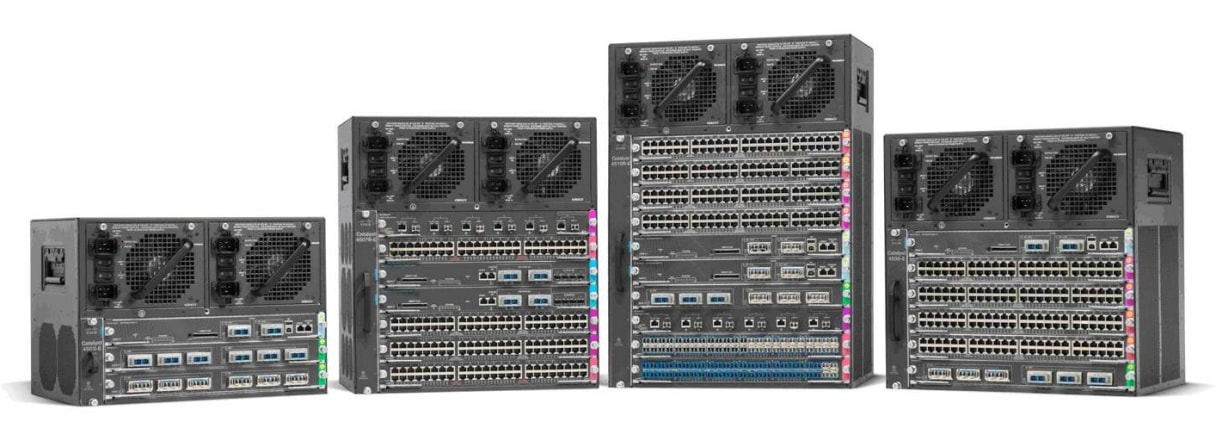
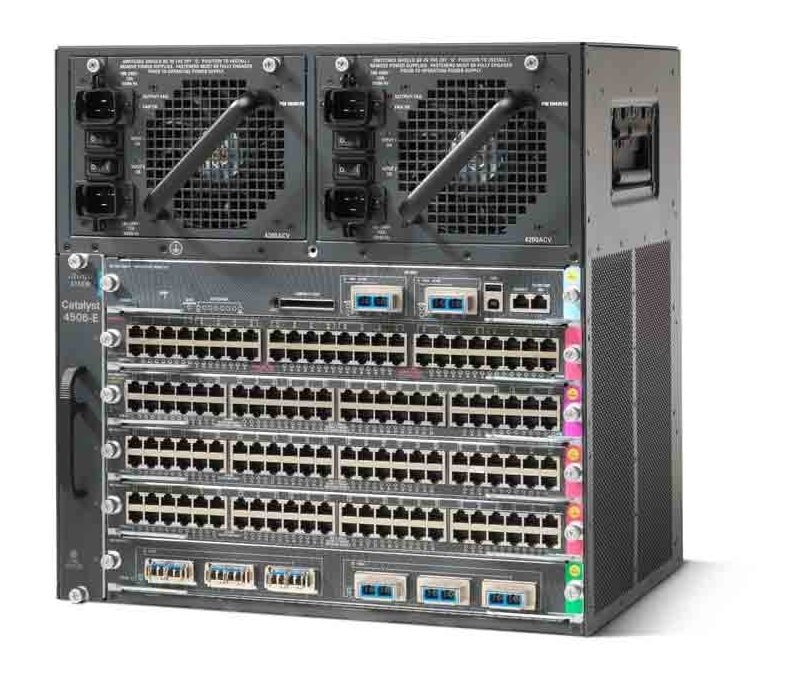
The Cisco Catalyst 4500 Series (Figure 1) includes four chassis options: Cisco Catalyst 4510R-E (10 slots), Cisco Catalyst 4507R-E (7 slots), Cisco Catalyst 4506-E (6 slots), and Cisco Catalyst 4503-E (3 slots). The Cisco Catalyst 4500 Series provides a common architecture, taking advantage of existing Cisco Catalyst 4000 Series line cards scaling up to 388 Ethernet ports. Offering compatibility with existing Cisco Catalyst 4000 and 4500 Series line cards, the Cisco Catalyst 4500 E Series extends its window of deployment in converged networks.
The Cisco Catalyst 4500 Series includes E-series supervisor engine and line cards and "classic" supervisor engines and line cards. The E-Series supervisor engines and line cards provide many enhancements, including 24 gigabits of switching capacity per line-card slot and aggregate forwarding performance of 250 million pps. Classic supervisors and line cards deliver 6 gigabits of switching capacity per line-card slot and forwarding performance up to 102 million pps.

Figure 1. Cisco Catalyst 4500 Series Switches

Convergence

In today's highly competitive business environment, a converged network plays a critical role in helping an organization gain a competitive advantage through increased productivity, organizational flexibility, and reduced operational costs. Integration of data, voice, and video on a single IP-based network, such as unified communications, requires a switching infrastructure that can distinguish each traffic type and manage it according to its unique requirements. The Cisco Catalyst 4500 Series provides a switching infrastructure that, when combined with Cisco IOS® Software, can deliver advanced nonstop services and control.

Secure and Nonstop Services

The Cisco Catalyst 4500 Series provides the network infrastructure for all applications that will be integrated to solve business problems. Extending intelligent network services with integrated resiliency leads to control of all traffic types with minimal planned or unplanned downtime. The Cisco Catalyst 4500 Series delivers this control with the following:

Integrated resiliency: Network downtime is minimized with redundant supervisor engine (subsecond failover) capability (Cisco Catalyst 4507R-E and 4510R-E switches), advanced fault tolerance software, full image In-Service Software Upgrades (ISSU), redundant fans, and 1+1 power-supply redundancy across the Cisco Catalyst 4500 Series. Integrated Power over Ethernet (PoE) in all Cisco Catalyst 4500 Series chassis simplifies network design and limits the number of points of failure for unified communications.

Advanced security: Support for Cisco patented Layer 2 security features prevents security breaches from rogue servers as well as "man in the middle" attacks where passwords and data can be intercepted. Layer 2-4 filtering and policing are also supported to mitigate the traffic initiated from malicious network attackers.

Sophisticated QoS: Integrated QoS and traffic-management capabilities based on Layer 2-4 classify and prioritize mission-critical and time-sensitive traffic, using Modular QoS CLI (MQC) and up to 64,000 QoS policy entries. The Cisco Catalyst 4500 Series can shape and rate-limit bandwidth-intensive traffic with mechanisms such as input and output policers based on host, network, and application information.

Comprehensive management: The Cisco Catalyst 4500 Series offers Web-based management for the configuration and control of all ports, allowing central management of critical network characteristics such as availability and responsiveness.

Scalable Architecture

Convergence lowers the overall cost of network ownership and simplifies administration and maintenance through the elimination of separate voice, video, and data infrastructures. The modular architecture of the Cisco Catalyst 4500 Series provides the scalability and flexibility to eliminate the need for multiplatform deployments, minimizing maintenance expenses. To further extend customers' network-equipment deployment cycles, the Cisco Catalyst 4500 Series offers the following features:

Backward compatibility of line cards: When upgrading to a new supervisor engine for enhanced capability, customers are given the flexibility to reuse existing line cards or upgrade to higher performance line cards without changing the complete system, postponing the need for additional capital expenditures.

Smooth technology migration: Customers have the option to smoothly migrate to wire speed IPv6 or 10 Gigabit Ethernet at their own pace. Concurrent IPv6 and IPv4 deployments with any number of IPv6 routes do not affect the total system wire-speed routing capacity. The TwinGig Converter and X2 modules supported on the E-Series supervisor and the 10 GigabitE-Series line card enable customers to increase network performance from Gigabit Ethernet to 10 Gigabit Ethernet without a supervisor engine or line-card upgrade.

Extra room for future features: The Cisco Catalyst 4500 Series architecture was designed with generous amounts of hardware resources to support future features applicable to your network needs. With a simple Cisco IOS Software upgrade, you can receive the benefits of many hardware-enabled features without the need for a complete system upgrade.

Low power consumption: The Cisco Catalyst 4500 Series consumes less power because of its centralized hardware architecture design.

Cisco Catalyst 4500 Series Benefits

The Cisco Catalyst 4500 Series provides advanced, high-performance solutions for enterprise LAN access, small backbone networks, Layer 3 distribution points, and integrated SMB and branch-office solutions. Benefits include the following:

Performance: Delivering advanced switching solutions that scale bandwidth as ports are added, the Cisco Catalyst 4500 Series is powered by leading-edge, application-specific integrated circuit (ASIC) technology that offers wire-speed Layer 2-3 10/100 or gigabit switching. Providing modular supervisor flexibility with complete line-card compatibility, Layer 2 switching can scale up to 320 Gbps, 250 mpps. Using Cisco Express Forwarding, Layer 3-4 switching can also scale up to 320 Gbps, 250 mpps.. Switching performance is independent of the number of route entries or advanced Layer 3 services enabled.

Bandwidth protection for mission-critical applications: When deploying the Cisco Catalyst 4500 Series Supervisor Engine, there is no degradation of forwarding performance with QoS or security features enabled; the Cisco Catalyst 4500 Series platform continues to forward at full line rate.

Port density: The Cisco Catalyst 4500 Series meets network-element connectivity requirements of up to 388 Ethernet ports in a chassis. The Cisco Catalyst 4500 Series supports the industry's highest-density 10/100/1000 autosensing, autonegotiating Gigabit Ethernet from the network edge directly to desktop computers. 10 Gigabit Ethernet uplink ports help enable high-density Gigabit Ethernet-to-the-desk deployments and switch-to-switch applications. Cisco Catalyst 4500 E-Series switches have 10G uplinks with twin gig converters as standard allowing easy migration path to the customers from Gigabit to 10 Gi Gigabit uplinks. The hot-swappable, modular, easy-to-use switching solution of the Cisco Catalyst 4500 Series reduces complexity and easily supports the changing desktop environments of today's networks.

Power over Ethernet (PoE): The Cisco Catalyst 4500 Series supports the 802.3af standard for PoE on 10/100 or 10/100/1000 ports, allowing customers to support telephones, wireless base stations, video cameras, and other appliances. Catalyst 4500 E-Series offers PoEP-ready Line Cards for devices that require up to 30W power per port. PoE makes it possible to place devices in unique locations without having to provide new outlets and costly electrical circuits. Moreover, PoE allows businesses to isolate critical devices on a single power system, so the entire system can be supported by uninterruptible power supply (UPS) backup.

• All Cisco Catalyst 4500 Series PoE line cards can support 15.4 watts (W) of power per port simultaneously. Not only do the cards support the IEEE standard, including the optional power classifications, but the Cisco prestandard power implementation is also supported to help ensure backward compatibility with existing Cisco powered devices. The cards are compatible with any Cisco Catalyst 4500 Series chassis and supervisor engine. Most importantly, the Cisco Catalyst 4500 Series has the power supplies and accessories to support 15.4W per port on every port simultaneously in any fully loaded chassis. The Catalyst 4500 PoEP-ready Line Cards support up to 30W of power per port.

Supervisor engine redundancy: The Cisco Catalyst 4507R-E and 4510R-E chassis support 1+1 supervisor engine redundancy for integrated resiliency. Redundant supervisor engines help minimize planned and unplanned network downtime, facilitating business continuance and increasing employee productivity. Nonstop Forwarding with Stateful Switchover (NSF/SSO) offers continuous packet forwarding during supervisor engine switchover. NSF/SSO dramatically improves the network's reliability and availability in a Layer 2 or Layer 3 environment. Full image ISSU enables rapid, nondisruptive software upgrades for new line cards, new power supplies, new features, or bug fixes, without any route flaps or network instabilities. IP phone calls do not drop even when the Cisco IOS Software images are upgraded or downgraded. NSF/SSO and ISSU are essential for business-critical applications such as voice over IP (VoIP).

Investment protection: The flexible modular architecture of the Cisco Catalyst 4500 Series provides cost-effective interface upgrades for LAN access or the branch-office network. Customers deploying the Cisco Catalyst 4500 switches with older supervisor engines who want higher performance and enhanced features can easily upgrade to the Cisco Catalyst 4500 Series Supervisor Engine II-Plus, Cisco Catalyst 4500 Series Supervisor Engine II-Plus-TS, Cisco Catalyst 4500 Series Supervisor II-Plus-10GE, Cisco Catalyst 4000/4500 Supervisor Engine IV, Cisco Catalyst 4000/4500 Supervisor Engine V, Cisco Catalyst 4500 Series Supervisor Engine V-10GE, Cisco Catalyst 4500 Series Supervisor Engine 6-E or Cisco Catalyst 4500 Series Supervisor Engine 6L-E. Compatible sparing between the Cisco Catalyst 4500 Series chassis provides commonality of power supplies and switching line cards, lowering the overall deployment, migration, and support costs.

Functionally transparent line cards: Cisco Catalyst 4500 Series systems can easily upgrade all system ports to higher-layer switching functions by simply adding a new supervisor engine. Higher-layer functional enhancements are possible on all system ports without replacement of existing line cards and wiring, unlike conventional switching products, where complete equipment upgrades are typical during migration. This architectural advantage extends the useful deployment life of Cisco Catalyst 4500 Series line cards.

Consistent software architecture: Because of the consistent Cisco Catalyst software and user interfaces, you can take advantage of your knowledge base and continue to grow your infrastructure using a combination of Cisco Catalyst 2960, 3560, 4500, and 6500 Series Switches and Cisco Catalyst 3750 Switches.

Cisco IOS Software network services: Cisco Catalyst 4500 Series switches provide mature enterprise Layer 2-3 features capable of enhancing corporate networks. These features meet the advanced networking demands of medium-sized and large enterprise businesses because they have been improved based on years of customer feedback.

Advanced security: Enabling security features such as 802.1x, access control lists (ACLs), Secure Shell (SSH) Protocol, unicast RPF (uRPF), port security, Dynamic ARP Inspection (DAI), IP Source Guard, Control Plane Policing, 802.1x Inaccessible Authentication Bypass, 802.1x Unidirectional Controlled Port, MAC Authentication Bypass, Multidomain Authentication, and private virtual LANs (PVLANs) on the Cisco Catalyst 4500 Series enhances control and flexibility in the network. By enabling these features selectively or collectively, a network administrator can prevent unauthorized access to servers or applications, allow different people to use the same PC with different permissions, prevent network intruders from stealing usernames and passwords to access switches, or prevent a deliberate or accidental broadcast storm.

Hardware-based multicast: Protocol Independent Multicast (PIM), dense and sparse mode, Internet Group Management Protocol (IGMP), Multicast Listener Discovery (MLD) snooping, and Cisco Group Management Protocol support standards-based and Cisco technology-enhanced efficient multimedia networking without compromising performance.

Manageability: The Cisco Catalyst 4500 Series is supported by the CiscoWorks product line, which provides innovative tools to centrally manage critical network characteristics such as availability, responsiveness, resilience, and security for the intelligent switching infrastructure. A common modular QoS command-line interface (CLI) simplifies the creation of policy traffic maps and delivers a consistent interface across large and small Cisco Catalyst switches. Network operations are enhanced with flexible Web-based, GUI-based, and CLI-based management alternatives. Best of all, behind every Cisco Catalyst 4500 Series Switch are Cisco service and support solutions.

Cisco NetFlow Services: The Cisco NetFlow Services Card for the Supervisor Engine IV and Supervisor Engine V supports statistics capture in hardware for flow-based and VLAN-based statistics monitoring. This data can be exported, collected, and analyzed for virus detection and mitigation, network-traffic accounting, usage-based network billing, network planning, network monitoring, and data-mining capabilities for both service provider and enterprise customers. Note: NetFlow support on the Supervisor Engine V-10GE is built into the hardware and does not require the NetFlow Services Card.

Gigabit to the desktop: The Cisco Catalyst 4500 Series already provides numerous 1000-Mbps desktop and server switching solutions. The scope of its gigabit solutions is easily extended to the desktop, with 48-port and 24-port triple-speed autosensing and autonegotiating 10/100/1000BASE-T line cards for the Cisco Catalyst 4500 Series. The triple-speed 48-port and 24-port modules, with autosensing technology, provide LAN investment protection by allowing Fast Ethernet desktops to migrate to Gigabit Ethernet in the future without replacement of the line cards.

• The Supervisor Engine 6-E, Supervisor Engine 6L-E, Supervisor Engine V-10GE and Supervisor Engine II-Plus-10GE provide two wire-speed 10 Gigabit Ethernet uplinks that are optimized for 10/100/1000BASE-T-to-the-desktop aggregation. 10G uplinks are a standard on Catalyst 4500 E-series switches.

Fiber to the desktop: The Cisco Catalyst 4500 Series 100BASE-X line cards offer the security and resiliency features of fiber-optic cable plants, making them ideal for networks with distance limitations, intrusion vulnerabilities, or RF interference. Enterprise customers or government agencies that process confidential information or offer e-commerce will appreciate the security benefits of these line cards.

Applications

Multilayer Switched Enterprise Network with Ethernet Backbone

Today's leading-edge network designs use a combination of Layer 2 and 3 services in the LAN (Cisco Catalyst 4500 Series) and Layer 3 routing in the distribution and core-network layers ( 6500 Series), see Figure 2. The Cisco Catalyst 4500 Series supports IP-only routing in hardware (Internetwork Packet Exchange [IPX] protocol and AppleTalk in software) with the Cisco Catalyst 4500 Series Supervisor Engines. For the medium sized business which also uses a tiered network design as shown in Figure 2, the Cisco Catalyst 4500 Series may also be used in the Distribution Layer.

Figure 2. Large Enterprise Network with Cisco Catalyst 4500 Series Switches

Cisco Catalyst enterprise solution advantages include the following:

• VLAN trunking maximizes uplink usage

• ASIC-based wire-speed Layer 2 and Layer 3 performance

• Mature Hot Standby Router Protocol (HSRP) provides Layer 3 redundancy

• Cisco UplinkFast, IEEE 802.3s, and IEEE 802.3w in the LAN provide Layer 2 resilience

• Traffic differentiation and service agreements benefit from the rich multilayer QoS-including policing (ingress and egress), classification, shaping, sharing, marking, and advanced scheduling-implemented in hardware with advanced parallel pipeline processing.

Medium-Sized Enterprise and Enterprise Branch-Office Applications

Cisco also offers a medium-sized enterprise design alternative with the Supervisor Engine IV, Supervisor Engine V, Supervisor Engine V-10GE, and Supervisor Engine 6-E, meeting the needs of value-conscious customers seeking a flexible and scalable LAN solution (Figure 3). Optimized for LAN access for medium-sized enterprises, the supervisor engines provide the performance and features to manage network applications now and in the future. They deliver nonblocking Layer 2-4 services to power resilient, intelligent multilayer switching solutions for converged data, voice, and video networks.

Figure 3. Cisco Catalyst Solution for Medium-Sized Enterprise

Small or Medium-Sized Enterprise and Branch-Office Applications

The Cisco Catalyst 4500 Series provides an ideal branch-office solution capable of meeting the needs of both small and large operations, as well as small-enterprise applications. The Supervisor Engine IV, Supervisor Engine V, Supervisor Engine V-10GE, and Supervisor Engine 6-E adds enhanced Layer 3 switching capabilities and gigabit wire-speed performance, allowing for deployment in a branch-office backbone network. Cisco IOS Software provides stable interconnection between other switches and WAN routers. Figure 4 shows a separate LAN switch and WAN router working together as a branch-office solution.

Figure 4. Small-Enterprise and Branch-Office Applications

Cisco Catalyst 4500 Series Features and Benefits

Table 1 lists the features and benefits of the Cisco Catalyst 4500 Series.

Table 1. Cisco Catalyst 4500 Series Features, Functions, and Benefits

Features

Functions and Description

Benefits

Cisco traffic integration

Integrates voice, video, and data into 1 campus infrastructure.

Lowers cost of ownership; improves productivity, investment protection, scalability, and performance.

Hardware

Modular 3-, 6-, 7-, and 10-slot Cisco 4500 E-Series chassis

Supports supervisor engine (up to two on the Cisco Catalyst 4507R-E and 4510R-E), power supplies with integrated PoE.

Provides a common architecture with advanced integrated resiliency that can be standardized for campuswide intranet needs.

320-Gbps capacity backplane

Provides enough capacity to forward wire-rate, nonblocking 250 mpps for IPv4 and 125 mpps for IPv6, and supports up to 8 switching modules.

Nonblocking, high-density application.

Flexible switching modules: standards-based, autosensing, and autonegotiating

Offer numerous interface choices: 10/100 Mbps Ethernet and 10/100/1000, 1000 Mbps Gigabit Ethernet, or 10000 Mbps 10 Gigabit Ethernet.

Accommodates IP campus LAN bandwidth growth, providing easy migration while scaling the network.

Integrated PoE

Provides power to devices attached to PoE-enabled Cisco Catalyst 4500 Series switch ports. Devices include IP phones, access points, video cameras, and other Cisco or IEEE 802.3af-compliant appliances.

Provides a single wire to the desktop; no cubicle uninterruptible power supply (UPS).

Fault-tolerant, load-sharing power supplies

Support 1 or 2 power supplies.

Increases reliability using multiple power supplies in a fault-tolerant configuration.

High Availability

Nonstop Forwarding (NSF) with Stateful Switchover (SSO)

Provides dual supervisor engines with subsecond failover. Layer 2 sessions remain up. Layer 3 forwarding continues during a routing event.

Helps ensure supervisor engine switchover is transparent to users in a Layer 2/3 environment.Provides Nonstop traffic forwarding for mission-critical applications and IP voice calls

SSO-Aware Hot Standby Router Protocol (HSRP)

Offers continuous data packet forwarding during a supervisor engine switchover without a path change to the standby HSRP router.

Adds supervisor redundancy over device redundancy with HSRP to minimize network recovery to a subsecond value.

In-Service Software Upgrade (ISSU)

Upgrades or downgrades a complete Cisco IOS Software image with minimal to no effect on a Cisco Catalyst 4500 system with redundant supervisor engines. Offers continuous packet forwarding during the supervisor engine switchover running different Cisco IOS Software versions.

Enables rapid, nondisruptive software upgrades for new line cards, new power supplies, new features, or bug fixes, without any route flaps or network instabilities. IP phone calls do not drop even when the Cisco IOS Software images are upgraded or downgraded. Eliminates planned downtime to maximize system and network availability.

Gateway Load Balancing Protocol (GLBP)

Protects data traffic from a failed circuit, while allowing packet load sharing between a group of redundant devices.

Provides for circuit redundancy while minimizing configuration. This improves the resiliency of the network and reduces administrative burden. GLBP devices also share packet-forwarding responsibilities, optimizing resource usage, thereby reducing costs.

Cisco IOS Software

Integrated Cisco IOS Software enhanced Layer 3 switching (Supervisor Engine IV, Supervisor Engine V, Supervisor Engine V-10GE, and Supervisor Engine 6-E)

Provides ASIC-based IP routing up to 256K routes at gigabit speeds (Open Shortest Path First [OSPF], Enhanced Interior Gateway Routing Protocol [EIGRP], Intermediate System to Intermediate System [IS-IS], and Border Gateway Protocol [BGP]).

Offers Layer 3 subnet control of network traffic; mature and proven routed protocols.

4096 VLANs

Helps to ensure that numerous switched VLANs are available for enterprise networks; allows users to select interfaces on multiple switches, networkwide, to create logical LANs.

Eases network administration by allowing users to be logically grouped together, regardless of physical interface location, for performance and security considerations; provides VLAN capability without forcing users to invest in new network technology.

VLAN Trunking Protocol (VTP)

Distributes VLAN configuration information.

Integrates Fast Ethernet VLANs.

Dynamic Trunking Protocol and 802.1Q

Dynamically configures trunk ports between Cisco Catalyst switches.

Minimizes VLAN trunk configuration, maximizes ready-to-use capabilities.

Private VLAN

Prevents users from seeing traffic generated by someone else on the same switch.

Helps to ensure privacy for users on the same switch.

Load balancing via spanning-tree priority on parallel Layer 2 trunks

Assigns spanning-tree priority on a per-VLAN basis.

Provides increased throughput and redundancy between Cisco Catalyst 4500 Series Switches.

Web Content Communication Protocol (WCCP) Version 2 Layer 2 Redirection

Enables transparent redirect content requests to the directly connected content engines using a Layer 2/MAC address rewrite.

Eliminates repetitive transmissions of identical content from the original content servers.

Multilayer switching

Supports Layer 2 (MAC), Layer 3 (IP address), and Layer 4 (TCP/UDP port) switching.

Provides desktop switching and integrated enhanced routing functions (Supervisor Engine IV, Supervisor Engine V, Supervisor Engine V-10GE, and Supervisor Engine 6-E) in the LAN, or as a small-enterprise backbone solution.

Cisco Discovery Protocol

Provides automated switch and router neighbor discovery.

Simplifies configuration management and helps enable a higher level of network services based on Cisco IOS Software.

Multicast switching

Provides hardware-based multicasting replication.

Provides standards-based multicasting with a forwarding performance that is line rate.

Comprehensive Security

ACL

MAC Authentication Bypass

Upon detecting a new MAC address on a switch port, the switch will proxy an 802.1x authentication request based on the device's MAC address. Allows any vendor's IP phone without an 802.1x supplicant to authenticate into the network. Enhances Cisco NAC Layer 2 802.1x.

Provides network access to agentless devices, including any vendor's IP phones, without 802.1x supplicant capabilities.

MAC Address Notification

Monitors the MAC addresses that are learned by, aged out, or removed from the switch.

Notifies if there is any potential DoS or man-in-the-middle attack.

Multidomain Authentication (MDA)

Allows any vendor's IP phone with an IEEE 802.1x supplicant and a single host behind the IP phone to independently authenticate into the network.

Provides enhanced security for IP phone deployments.

Unicast RPF (uRPF)

Examines all packets received as input on an interface to make sure that the source address and source interface appear in the routing table and match the interface on which the packet was received.

Helps mitigate problems caused by the introduction of malformed or forged (spoofed) IP source addresses into a network by discarding IP packets that lack a verifiable IP source address.

802.1x for Identity-Based Network Services

Using the 802.1x protocol with Cisco enhancements, the network grants privileges based on user logon information, regardless of the user's location or device.

Allows different people to use the same PC and have different capabilities, so that users only get their assigned privileges no matter how they are logged onto the network, preventing unauthorized access.

802.1x Inaccessible Authentication Bypass

Provides a configurable alternative on the switch to grant a critical port network access in a locally specified VLAN.

Minimizes business effect for the duration of the AAA server outage.

802.1x Unidirectional Controlled Port

Allows the Wake-on-LAN (WoL) magic packetsto reach a workstation attached to an unauthorized 802.1x switch port.

Expands the WoL operations to workstations attached to 802.1x switch port.

Traffic Management

Modular QoS CLI (MQC)

Provides QoS for both Layer 2 class of service (CoS) and Layer 3 type of service (ToS), traffic shaping, sharing, policing, and congestion avoidance with Dynamic Buffer Limiting (DBL).

Provides centralized control of prioritization of networkwide traffic; easily creates and manages policies to protect mission-critical applications.

Ingress and egress policing

Sequentially classifies packets at entrance and then reclassifies and remarks at exit on a per-port and per-VLAN basis.

Provides granular traffic control by user-defined traffic classifications to help ensure QoS policy.

Control Plane Policing

Provides a unified solution to rate limit the CPU-bound control plane traffic in hardware.

Prevents malicious DoS attack traffic from overwhelming the supervisor CPU and helps ensure network stability, availability, and predictable performance by controlling the traffic to the supervisor CPU.

Multiple queues on every port interface

Provides multiple queue (up to 8 queues) classification with dynamic queue sizing and scheduling of network traffic on a packet-by-packet basis.

Differentiates network traffic to improve traffic control and latency; helps enable sophisticated QoS for superior data, voice, and video traffic.

Network and Switch Management

Embedded Remote Monitoring (RMON)

Provides four RMON groups on all ports:

• Statistics
• History
• Alarms
• Events

Delivers efficient and effective workgroup troubleshooting tools.

Furnishes analysis tools to help managers tune network performance.

Helps identify heavy network users as candidates to move to dedicated or higher-speed ports.

Proactively monitors the switched internetworking centralized management using CiscoWorks solutions.

Industry standards-based.

Enhanced Switch Port Analyzer (SPAN)

Allows for monitoring of a single port or multiple (VLAN) ports via a single monitor port, with up to any combination of input /output sessions , up to a maximum of 8 sessions

Helps managers to use existing network analyzers to troubleshoot switched internetworking.

Preserves the network visibility that might otherwise be lost by switches that do not support SPAN.

Delivers an analysis path into a company's VLAN architecture.

Remote SPAN

Allows monitoring of multiple switches across the network from a single switch.

Reduces the number of analyzers necessary to monitor networks.

Password-Protected Administration Interface

Requires password for local or remote access using Telnet or SSH.

Provides protection from unauthorized configuration changes.

Local (in-band) management

Supervisor engine has an EIA/TIA-232 interface for modem- or console-terminal connection.

Manages the Cisco Catalyst 4500 Series from a directly attached, low-cost terminal or PC.

Remote (out-of-band) management through SNMP sets or Telnet (client) connection

Accessible through any switched interface.

Manages Cisco Catalyst 4500 Series Switches from anywhere in the network.

Management console

CLI.

Provides easy-to-use ASCII text interface that requires no special applications.

Takes advantage of support staff's Cisco Catalyst knowledge.

Full Simple Network Management Protocol (SNMP) management (for Ethernet MIB, MIB II, VTP, and system extensions)

Allows the Cisco Catalyst 4500 Series to be managed from any SNMP-based management station.

Eases management from installed network management platforms.

Extends VLAN configuration to SNMP management software.

Secure Copy Protocol (SCP)

Onboard Flash memory for Trivial File Transfer Protocol (TFTP) download and upload of operating software

Remotely downloads new revisions of an operating system without hardware changes.

Reduces cost of administering software upgrades by providing centralized network- management capability.

Removable Compact Flash memory on supervisor engines

Allows Cisco IOS Software images and configuration-setting storage.

Supports centralized corporate administration with easy distribution of configuration and software standards across the enterprise.

Cisco and Partner Services: Essential to Campus Success

Cisco and our certified partners can help you prepare your network and teams as you adopt new technologies to transform your business. We can help you establish a secure, resilient architecture and successfully integrate Cisco Unified Communications and mobility technologies. Planning and design services align technology with business goals and can increase the accuracy, speed, and efficiency of deployment. Technical services help maintain operational health, strengthen software application functionality, solve performance issues, and lower expenses. Optimization services are designed to continually improve performance and help your team succeed with new technologies. For more information, visit http://www.cisco.com/go/services.